We've been with Magazine Manager for over 8 years. Their digital tearsheets feature alone SAVED ME over $9,000 a year by not having to buy stamps, envelopes, paper, toner, or pay a staff member to stuff envelopes with invoices.
Manual billing costs publishers more than slow payments — it costs them advertiser relationships, staff hours, and predictable cash flow.
For magazine publishers, slow invoicing is more than an inconvenience — it is a cash flow crisis hiding in plain sight. When billing cycles rely on manual data entry, paper invoices, and disconnected spreadsheets, payments stall, errors multiply, and your sales team spends valuable hours following up instead of selling. Industry research consistently shows that best-in-class companies complete the invoice cycle far faster than the average business. For publishers managing multi-issue contracts, agency commission splits, and production-linked billing, the gap is even wider.
This guide walks you through how electronic invoicing transforms the billing process for publishers, covering the tools, workflows, and best practices that get invoices out faster and money in sooner. Whether you are managing a handful of advertisers or hundreds of insertion orders across multiple publications, you will find actionable strategies here — including how The Magazine Manager, the world's leading magazine software, brings invoicing, ad management, and CRM together in one seamless platform to eliminate the bottlenecks that cost publishers time and revenue.
When a software company invoices a client, the transaction is relatively straightforward: a service was delivered, an amount is owed, and a single invoice captures the exchange. Publisher invoicing operates in an entirely different dimension of complexity — one that generic accounting tools and standard billing advice were never designed to handle.
At the heart of the difference is the insertion order. Before a single ad runs, publishers negotiate and confirm placements through IOs that specify issue dates, ad sizes, positions, rates, and special requirements. A single advertiser might hold an IO covering six consecutive issues, with different creative specifications and pricing tiers for each. Translating that multi-issue commitment into accurate, timely invoices requires tracking every variable across an extended production calendar — a task that has no real equivalent in most other industries.
Agency commission structures add another layer that generic billing systems simply ignore. When an advertiser books through a media buying agency, the agency typically earns a commission — an industry-standard percentage deducted from the gross rate. Publishers must invoice at the gross amount, track the agency discount separately, and reconcile net revenue accordingly. Billing the wrong party, applying the wrong commission rate, or conflating gross and net figures creates disputes that can delay payment for weeks and damage relationships with agencies whose goodwill publishers depend on across multiple clients.
Co-op billing introduces yet another dimension. Many retail advertisers receive partial reimbursement from their manufacturers or brand partners for advertising spend. Publishers are often asked to produce co-op-compliant invoices that meet the specific documentation requirements of those manufacturer programs — particular formats, affidavits of publication, tear sheets, and itemized breakdowns. A generic invoice template satisfies none of these requirements.
Then there is the issue-cycle timing problem. Unlike a subscription service that bills on a predictable monthly cadence, magazine publishers invoice against publication dates that shift with editorial calendars, special issues, and print production schedules. An advertiser who runs in a quarterly special edition may not receive an invoice until weeks after a standard billing cycle would have triggered one, creating cash flow gaps that compound across a full publishing year. Industry research has found that best-in-class companies complete the invoice cycle significantly faster than the average business — a gap that widens further when manual, publication-cycle-dependent billing is involved.
Finally, publishers routinely manage hundreds of active accounts simultaneously — each with its own rate card, contract terms, agency relationships, and billing contacts. The sheer volume of variables means that manual or generic billing processes do not just create inefficiency; they create structural risk of error at every step. Understanding this complexity is the first step toward choosing tools and workflows genuinely built for the publishing industry.

Most publishers carry two distinct revenue streams under the same roof, yet treat their billing infrastructure as if one size fits all. Advertising revenue and subscription revenue are fundamentally different animals, and conflating them — or forcing them through the same manual process — is one of the most common sources of delayed payments and reconciliation headaches in publishing.
Advertising billing begins long before an invoice is ever generated. It starts with an insertion order: a formal agreement that locks in ad placement, issue dates, size, rate, and any agency commission structure. Once a campaign runs, the publisher must reconcile actual placements against what was booked, apply any make-good adjustments, calculate agency commissions at the agreed rate, and only then produce an invoice that accurately reflects what ran. If a campaign spans multiple issues or involves co-op arrangements, that reconciliation layer multiplies in complexity. Sending an invoice before this process is complete almost guarantees a dispute — and disputes push payment timelines out by weeks.
Subscription billing operates on an entirely different logic. Here the triggers are time-based rather than placement-based: renewal cycles, grace periods, auto-renew flags, promotional rate expirations, and dunning sequences for failed payments. The invoice itself is simpler, but the workflow surrounding it — particularly for publishers managing both print and digital access tiers — demands its own automation layer to prevent lapses and revenue leakage.
The problem most publishers encounter is that their billing tools were designed with only one of these models in mind. Accounting software built for general business handles subscriptions reasonably well but has no concept of an insertion order, agency split, or campaign reconciliation. Ad-specific tools, meanwhile, rarely include the renewal logic and subscriber lifecycle management that circulation revenue demands.
The Magazine Manager is built specifically for this dual reality. Its integrated billing system connects insertion order management, agency commission tracking, and campaign reconciliation directly to the invoicing engine — so advertising invoices reflect what actually ran, not just what was booked. At the same time, subscription billing workflows handle renewal cycles, access tiers, and payment retries within the same platform through ChargeBrite, Mirabel's integrated subscription and recurring billing platform. Publishers gain a single source of truth for both revenue streams, eliminating the manual handoffs between disconnected systems that slow payments and introduce errors.
Subscription revenue is the lifeblood of many magazine operations, yet it is also the revenue stream most vulnerable to quiet leakage. Failed payments that go unretried, expired cards that are never updated, and lapsed subscribers who were never sent a timely renewal reminder all represent revenue that evaporates without a single visible error message. Unlike advertising billing — where a missed invoice is usually noticed quickly — subscription revenue loss is gradual and easy to overlook until it shows up as a meaningful drop in circulation numbers.
The mechanics of subscription billing demand a different kind of automation than advertising invoicing. Where ad billing is event-driven (an issue closes, an ad runs, an invoice fires), subscription billing is calendar-driven. Each subscriber has their own renewal date, their own payment method on file, and their own history of engagement with the publication. Managing these variables at scale — across thousands of active subscribers, multiple access tiers, and a mix of print, digital, and bundled plans — is simply not feasible with manual processes or general-purpose billing tools.
Dunning management is one of the most consequential capabilities in subscription billing. When a payment fails — because a card has expired, a bank has flagged the transaction, or a billing address has changed — the publisher has a narrow window to recover that subscriber before they lapse. Effective dunning sequences retry the payment on an optimized schedule, send branded reminder communications to the subscriber, and in some implementations automatically update card details through card-account-updater services. Publishers who lack automated dunning lose a meaningful share of their subscriber base to involuntary churn — subscribers who intended to renew but whose payment simply failed without follow-up.
Renewal reminders are equally important. Subscribers who receive advance notice of an upcoming renewal — with a clear summary of what they are paying for and an easy path to update their payment details — renew at higher rates than those who receive no communication until their access lapses. The timing, frequency, and content of these reminders can be configured in a purpose-built subscription platform to match the publisher's audience and renewal cycle.
ChargeBrite, Mirabel's subscription-automation and recurring-billing platform, is built directly into The Magazine Manager to handle exactly these workflows. It manages recurring billing, smart dunning, renewal reminders, and self-service subscriber portals — all connected to the same CRM that houses your advertiser records, your editorial calendar, and your audience data. Publishers do not need a separate subscription management tool bolted onto their publishing platform; the subscription billing layer is native, and subscriber revenue flows into the same reporting environment as advertising revenue, giving finance teams a complete picture of the business in one place.
From agency commissions to disputed invoices, here is the concrete checklist of billing friction points that electronic invoicing platforms address natively for magazine publishers.
Publishers routinely bill advertising agencies at gross rate, then must account for the applicable agency commission before reconciling actual revenue. Manual systems force billing staff to calculate and track these deductions invoice by invoice. Electronic invoicing platforms built for publishers apply commission rules automatically at the client or agency level, so the net amount due is calculated correctly from the first draft — eliminating back-and-forth adjustments and reducing the risk of over- or under-collecting.
Many advertisers run co-operative campaigns where a portion of the invoice is billed to a manufacturer or parent brand rather than the direct buyer. Tracking split billing across two or more payers is a persistent source of errors in spreadsheet-based workflows. E-invoicing systems allow publishers to assign billing splits at the order level, automatically generating separate invoices to each responsible party and keeping the full campaign record intact in one place.
A single advertiser contract often spans six, twelve, or more issues with varying rates, sizes, and positions. Manually generating an invoice for each insertion — and matching it back to the original contract — consumes significant staff time and creates version-control problems. Electronic systems tied to an ad order automatically generate insertion-level invoices on the correct schedule, pulling confirmed run dates, rates, and specs directly from the production record.
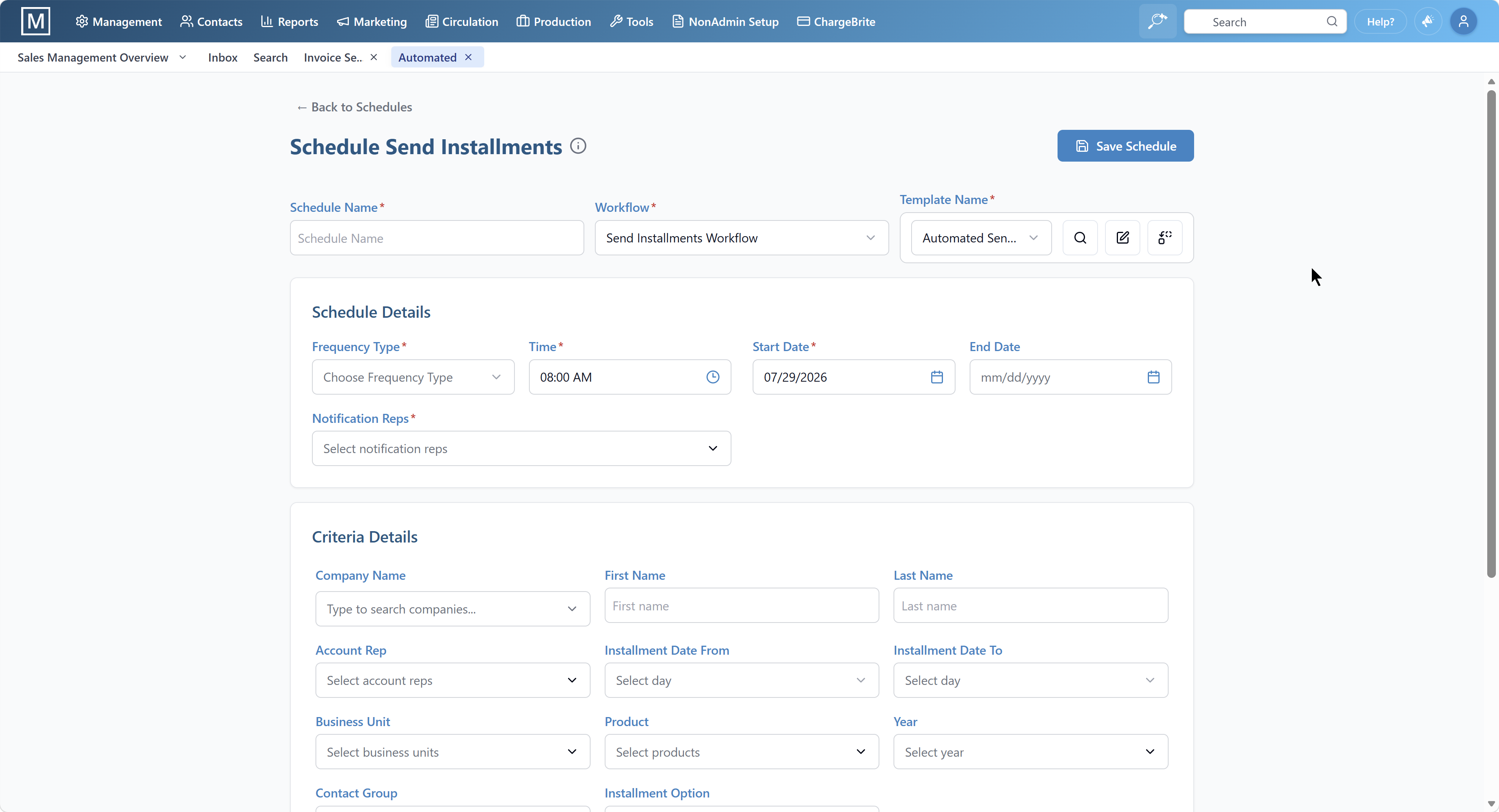
Advertisers frequently pay in installments, particularly for large annual contracts. Reconciling partial payments against open invoices, calculating remaining balances, and issuing updated statements manually is error-prone. E-invoicing platforms apply payments to the correct invoice line, update outstanding balances in real time, and can trigger automated reminders when a scheduled installment is approaching or overdue.
Missed deadlines, publication errors, or cancelled insertions all require credit memos that must be tied back to the original invoice for accurate revenue reporting. Electronic systems create and link credit memos directly to source transactions, keeping the audit trail clean and ensuring that adjusted figures flow correctly into accounts receivable and revenue reports without manual journal entries.
Agencies and advertisers regularly dispute invoices when they cannot verify that an ad ran as contracted. E-invoicing platforms that integrate with ad management and production records allow publishers to attach tear sheets, digital proof-of-placement, and signed insertion orders directly to the invoice, resolving disputes faster and reducing the number of invoices that age past 60 or 90 days.
Paper-based billing does not just slow your team down — it quietly drains cash flow, inflates overhead, and creates reconciliation headaches that are unique to advertising-driven publishing.
Every handoff between sales, production, and AR is a chance for an error — and every error extends the payment clock by days or weeks.
For publishers whose revenue depends on advertising, manual invoicing carries a compounding set of costs that general businesses rarely face. A typical ad sale generates an insertion order, a production schedule, a proof-of-publication record, and sometimes an agency commission deduction — all of which must reconcile perfectly before a clean invoice can go out. When that process runs on spreadsheets, email threads, and printed documents, errors multiply at every handoff.
The cost differential between paper and electronic invoicing is substantial and well-documented across the industry. Academic and industry research has consistently found that electronic invoicing can deliver significant cost savings for both the issuer and the receiver compared with paper-based processing. For publishers managing hundreds of advertiser accounts across multiple issues, those savings compound significantly.
Beyond cost, manual workflows expose publishers to insertion order discrepancies that general invoicing tools are not built to catch. When a sales rep closes a multi-issue contract and the billing team invoices from a separate system, mismatches in run dates, ad sizes, or rate card adjustments create disputes that stall payment further and consume staff time to resolve. Agency commission deductions add another layer: if the invoice does not reflect the agreed net rate, the agency short-pays and the publisher's AR team must chase the difference.
Paper invoicing also eliminates delivery certainty. Unlike electronic invoicing — where a supplier can instantly confirm receipt by the buyer — a mailed or emailed PDF invoice can sit unacknowledged for days, giving advertisers a convenient reason to reset payment clock expectations. Industry research has found that best-in-class companies complete the invoice cycle significantly faster than the average business. Publishers still relying on paper-based billing are not just slow — they are operating a workflow the modern finance team cannot reliably execute.
From signed ad order to cleared payment — a step-by-step look at what e-invoicing actually does inside a magazine operation
Electronic invoicing is not simply a PDF sent by email. For publishers, it is a connected sequence of automated actions that links your sales process directly to your accounting records and your advertiser's payment system. Understanding each stage shows where manual effort disappears and where faster payment becomes possible.
The process begins the moment a media order is confirmed in your CRM. Insertion order details — advertiser name, issue dates, ad sizes, rates, and any negotiated discounts — are locked into the system. Because the invoice will draw directly from this record, there is no re-keying of data and no opportunity for transcription errors to inflate your days-sales-outstanding.
Once the order is finalized, the system generates a structured invoice automatically. In a platform like The Magazine Manager, billing rules you have configured — net terms, tax codes, agency commission splits — are applied without manual intervention. The invoice is assigned a unique reference number and timestamped, creating an auditable record from the first moment of its existence.
The invoice is transmitted directly to the advertiser or agency through a digital channel — typically a secure email link, a client-facing portal, or an integrated accounts-payable network. Unlike a mailed paper invoice, electronic delivery is instantaneous and traceable. The system logs exactly when the document was sent and, in many implementations, when it was opened or downloaded by the recipient.
The advertiser reviews the invoice through the same digital channel. If the details match their purchase order, they confirm receipt electronically. If there is a discrepancy — a rate difference or a missed make-good — the query is raised within the system rather than through a chain of phone calls. Your team sees the dispute immediately and can resolve it against the original order record, cutting resolution time significantly.
Once confirmed, the advertiser initiates payment through their preferred method — ACH transfer, credit card, or a connected payment gateway. The incoming payment is matched automatically against the open invoice in your billing module. Your accounts-receivable ledger updates in real time, eliminating the manual bank-statement reconciliation that typically consumes hours at month-end close. The full audit trail — order, invoice, confirmation, payment — lives in one connected record.
Implementing electronic invoicing is not simply a matter of switching software. Publishers who get the most from e-invoicing treat it as a workflow redesign, not just a technology upgrade. The following best practices reflect what works in practice for advertising-driven media operations.
Standardize your rate card before you automate. Electronic invoicing systems generate invoices from the data they are given. If your rate cards contain inconsistencies — different reps quoting different rates for the same placement, frequency discounts applied ad hoc, or agency commission rates that vary without a documented policy — those inconsistencies will be automated along with everything else. Before you connect your ad order system to your invoicing engine, audit your rate card and establish clear rules for every pricing variable. The discipline pays off immediately in fewer invoice disputes.
Align billing triggers with production confirmation, not booking. One of the most common sources of invoice disputes is billing for an ad before confirming it ran. In a well-configured publishing platform, the invoice trigger is tied to production status — the ad is confirmed as placed in the issue before the billing event fires. This single workflow change eliminates an entire category of dispute: the advertiser who receives an invoice for an ad that was bumped, resized, or repositioned without their knowledge.
Configure agency accounts before the first invoice goes out. Agency commission rates, billing contacts, and purchase order requirements should be set up at the account level in your CRM before you generate a single invoice for agency-placed business. Retroactively correcting commission calculations or re-issuing invoices to the correct billing contact is time-consuming and damages the agency relationship. Getting the configuration right upfront means every subsequent invoice is correct automatically.
Use client portals to reduce inbound billing inquiries. A significant share of the time your billing team spends on the phone is answering questions that a self-service portal could answer instantly: What is my current balance? Has my payment been received? Can I get a copy of my invoice? Publishers who deploy client portals — where advertisers can view their account history, download invoices, and make payments without calling — report meaningful reductions in billing-related inbound volume. That time goes back to revenue-generating activity.
Close the loop between invoicing and your accounting system. Electronic invoicing only delivers its full value when the payment data flows back into your accounting records automatically. If your billing platform and your accounting software require a manual export-import step to stay synchronized, you have not eliminated reconciliation work — you have just moved it. Native integrations with accounting platforms like QuickBooks or Xero ensure that payments applied in your publishing CRM are reflected in your financial records without a separate step, keeping month-end close fast and accurate.
Review your AR aging report weekly, not monthly. One of the most underused capabilities of electronic invoicing platforms is real-time accounts-receivable reporting. Publishers who review their AR aging weekly — rather than waiting for month-end — catch overdue invoices while the advertiser relationship is still warm and the payment is still within a reasonable collection window. Automated reminders help, but a human review of aging accounts adds a layer of judgment that automation cannot fully replace.
Agency and Programmatic Billing
For publishers who sell a significant portion of their inventory through media buying agencies or programmatic channels, electronic invoicing is not simply a matter of sending a PDF faster. The billing relationships involved are structurally different, and your e-invoicing platform needs to reflect that complexity accurately.
Agency workflows typically involve commission splits, where the agency earns an agreed percentage of the gross buy, and the publisher invoices the net amount after deducting that commission. A capable e-invoicing system should allow you to configure agency commission rates at the account level, automatically calculate net billing amounts, and produce invoices that clearly itemize gross rate, commission deduction, and net due. This eliminates the manual recalculation that causes discrepancies and slows payment approvals inside agency accounting departments.
Agencies also operate on their own billing cycles and often require invoices formatted to match their internal purchase order systems. Electronic invoicing platforms that support structured data formats can feed directly into agency accounts payable systems, reducing the back-and-forth that delays reconciliation. When invoice line items map cleanly to the agency's own order references, approvals move faster and disputes drop.
On the programmatic side, reconciliation is the central challenge. Programmatic campaigns generate impression data, viewability metrics, and delivery reports that must be matched against what was contracted before an invoice can be issued with confidence. Publishers who invoice before completing this reconciliation routinely face short-payments or disputes from agencies whose own data shows different delivery numbers. An integrated publishing platform that connects ad delivery data to the invoicing engine — so that invoices are generated from confirmed delivery records rather than booked estimates — eliminates this category of dispute entirely.

One of the most underappreciated complexities of publisher billing is that invoicing does not happen on a fixed monthly cadence — it happens on an editorial one. A magazine with six issues per year has six billing events, each tied to a specific close date, print production milestone, and distribution window. A special issue added mid-year creates a seventh. A delayed print run pushes the billing event with it. Generic billing software, which assumes invoices go out on the first of the month or at the end of a service period, has no concept of this rhythm.
The practical consequence is that publishers using general-purpose billing tools must manually trigger invoicing each time an issue closes — pulling the relevant orders, verifying what ran, and generating invoices as a separate administrative task disconnected from the production workflow. This manual trigger is one of the most common sources of billing delay in publishing operations. When the production team is focused on closing an issue, billing is an afterthought. Invoices go out days or weeks after the issue closes, and the payment clock does not start until they do.
In a purpose-built publishing platform, the issue close date is a first-class event in the system. When an issue is confirmed as closed and ads are marked as run, the billing trigger fires automatically from the production status. Invoices are generated from the confirmed placement records — not from a separate billing queue that someone has to remember to process. The result is that invoices go out on the day the issue closes, or within hours of it, rather than days or weeks later.
This alignment between editorial production and billing has a direct impact on days sales outstanding. An invoice that goes out the day an issue closes gives the advertiser the maximum time within their payment terms to process and pay. An invoice that goes out two weeks later — because the billing team was waiting for production confirmation that never came through a formal channel — effectively shortens the advertiser's payment window by two weeks, which often pushes payment past the due date through no fault of the advertiser.
For publishers with complex editorial calendars — multiple titles, themed special issues, regional editions, and digital-only issues running on different schedules — the ability to configure billing triggers at the issue level, rather than at a fixed calendar interval, is essential. It means that a quarterly print title and a monthly digital edition can each have their own billing cadence, managed within the same platform, without requiring separate billing workflows or manual calendar management.
Publishers evaluating electronic invoicing platforms should ask specifically how the system handles issue-based billing triggers: whether the billing event is connected to production status, whether it can be configured per title and per issue type, and whether the invoice generation is automatic or still requires a manual step once production confirms. The answer to those questions determines whether the platform genuinely fits the publishing workflow or simply digitizes the same manual process that was causing delays before.

Key Takeaway
A purpose-built publishing platform connects the issue close date directly to billing — so invoices go out automatically the moment production confirms, not days later.
Beyond the mechanics of generating and delivering an invoice, publishers face three recurring billing patterns that expose the limits of generic invoicing tools and reward platforms built specifically for media businesses.
ACH payment acceptance and its impact on publisher margins
For publishers collecting large advertising invoices — annual contracts, multi-issue packages, or significant digital buys — the payment method matters as much as the payment timing. Credit card processing fees, typically a percentage of the transaction value, can represent a meaningful cost on a five-figure advertising invoice. ACH transfers, which move funds directly between bank accounts, carry significantly lower processing costs and are widely used in B2B advertising transactions. Publishers whose billing platforms support ACH acceptance — and make it easy for advertisers to pay by ACH through a client portal or electronic payment link — can meaningfully reduce their payment processing overhead on large accounts. The Magazine Manager supports ACH through its integrated payment processing. Publishers evaluating platforms should confirm ACH support and understand the fee structure for each payment method before committing to a billing workflow.
Multi-channel revenue invoicing in a single billing run
Modern publishers rarely derive revenue from a single channel. A typical issue cycle might generate advertising revenue from print placements, digital display units, sponsored email newsletters, event sponsorships, and programmatic inventory — alongside subscription revenue from print and digital access tiers. Each of these revenue types has its own billing logic, its own delivery confirmation requirement, and potentially its own billing contact at the advertiser or agency. Publishers who manage these channels in separate systems — an ad server for digital, a spreadsheet for events, a separate subscription platform for circulation — face a reconciliation problem at billing time that is both time-consuming and error-prone.
Purpose-built publishing platforms address this by centralizing multi-channel order management and billing in a single environment. When a single advertiser has a print insertion, a digital display buy, and an event sponsorship in the same billing period, a unified platform can generate a consolidated invoice covering all three line items — or separate invoices per channel, depending on the advertiser's preference — from a single confirmed order record. The Magazine Manager's billing engine handles advertising orders across print, digital, email, programmatic, and events within one platform, allowing publishers to invoice across all revenue channels without assembling data from multiple systems.
Auto-recurring invoicing for annual and multi-issue ad contracts
Annual advertising contracts are a staple of magazine publishing. A loyal advertiser who commits to twelve consecutive issues, or to a full-year digital sponsorship, represents predictable revenue — but only if the invoicing workflow is as reliable as the commitment. Under manual billing, annual contracts require someone to remember to issue an invoice for each billing period, reference the correct contract terms, and apply any frequency discounts or installment structures that were negotiated at the time of signing. Miss a billing cycle, and the cash flow projection for that period is wrong. Issue an invoice with the wrong rate, and the dispute process begins.
Electronic invoicing platforms that support auto-recurring invoice generation eliminate this risk. When an annual contract is confirmed in the system, the billing schedule is configured at the same time — whether that means monthly installments, per-issue billing, or quarterly payments. The system generates and delivers each invoice automatically on the agreed schedule, referencing the original contract terms. The billing manager's role shifts from generating invoices to reviewing and approving them, a far lower-effort task that is also far less error-prone. For publishers managing dozens of annual contracts simultaneously, this shift from manual generation to automated review can represent a significant reduction in billing staff time per issue cycle.

Abstract arguments for e-invoicing are easy to make. What is harder — and more useful — is seeing exactly how the workflow change plays out inside a real publishing operation. The scenarios below represent the kinds of situations magazine publishers encounter every issue cycle, and how electronic invoicing changes the outcome in each one.
A regional lifestyle magazine sells a full-year contract to a local automotive group: six issues, full-page, with a frequency discount applied and an agency commission deducted because the buy came through a media agency. Under a manual system, the billing manager must recreate this calculation six separate times across the year — pulling the original insertion order, recalculating the net rate, and issuing a new invoice each issue. One transposition error in month three creates a dispute that delays payment by 45 days. With electronic invoicing tied directly to the insertion order, the system generates each issue's invoice automatically from the confirmed order data. The discount and commission are baked into the record from the moment the order is placed. The billing manager reviews and approves; the invoice goes out the same day the issue closes. The automotive group pays on time, every time, because the numbers are always right.
A B2B trade publisher runs a controlled-circulation print magazine alongside a paid digital edition. A subscriber's credit card expires in October — historically, this would mean a failed charge, a manual follow-up call from the circulation team, and a lapse in access while the subscriber hunts for their new card number. With automated dunning built into the billing system, the platform detects the failed charge, retries on an optimized schedule, and sends a branded payment-update email with a direct link to update card details. The subscriber updates their card within 48 hours without ever speaking to anyone on the circulation team. The renewal completes, the subscriber's access continues uninterrupted, and the circulation manager never knew there was a problem. Multiply this across hundreds of annual renewals and the operational savings become significant — one verified Capterra reviewer of The Magazine Manager noted that the digital tearsheets feature alone saved her over $9,000 a year by eliminating the cost of stamps, envelopes, paper, toner, and staff time spent stuffing invoice envelopes.
A national consumer magazine closes a significant digital advertising package with a large brand through its media agency. The package includes display units, a sponsored newsletter placement, and a half-page print ad in the following issue — three different media types, each with its own delivery confirmation requirement. Under a manual billing workflow, the finance team waits for the ad ops team to confirm delivery, then manually assembles a single invoice that covers all three line items, attaches tearsheets as PDF files, and emails the package to the agency's accounts payable contact. The agency's AP team flags a discrepancy between the invoice and the insertion order on the newsletter placement — a unit count that was updated mid-campaign but never reflected in the billing record. The dispute takes three weeks to resolve. With electronic invoicing connected to the ad order management system, the invoice is generated from the live order record, which already reflects the updated unit count. Tearsheets are attached automatically at the point of invoice generation. The agency receives a complete, accurate package on the day billing opens. Payment arrives within the agreed net-30 window.
A niche enthusiast magazine with a two-person sales team sells advertising to a mix of local businesses and national brands. For years, invoicing meant the publisher printing invoices, mailing them, and then following up by phone when payment did not arrive. Days Sales Outstanding regularly stretched past 60 days because advertisers simply forgot. After switching to electronic invoicing with automated payment reminders, the publisher configured the system to send a reminder at net-15 and a second reminder at net-25. Advertisers who previously needed three phone calls to pay now pay on the first or second automated reminder. The publisher's DSO dropped meaningfully in the first quarter after implementation — not because advertisers became more reliable, but because the system made it impossible for an invoice to go unacknowledged. The sales team, freed from collections follow-up, redirected that time toward prospecting new accounts. Industry research consistently shows that best-in-class operations complete the invoice cycle far faster than the average business — a gap that manual publishing operations feel acutely every issue cycle.
A city magazine runs a complex editorial calendar with special issues, themed sections, and premium placement options that command different rates. Historically, the production team tracked ad placements in one system, the sales team tracked orders in another, and the billing team worked from a spreadsheet that was updated — imperfectly — by both. When a premium back-cover placement was downgraded to an inside spread at the last minute due to a production conflict, the change was noted in the production system but never made it to the billing spreadsheet. The advertiser was invoiced at the premium rate. The dispute that followed damaged a long-standing advertiser relationship. With an integrated publishing CRM where ad order management, production workflow, and billing and invoicing automation share a single data record, a placement change in production automatically updates the order record. When billing opens, the invoice reflects the actual placement — not the originally sold one. The advertiser is billed correctly the first time, and the relationship stays intact.
A trade publication closes a large annual sponsorship package with a manufacturing company. The total contract value is substantial enough that the advertiser requests quarterly installment billing rather than a single annual invoice. Under a manual system, this means the billing manager must remember to issue four separate invoices across the year, each for the correct amount, each referencing the original contract. Miss one, and the cash flow projection for that quarter is off. Issue one late, and the advertiser's AP team has to scramble to process it before their own quarter closes. With electronic invoicing configured for installment billing, the system schedules all four invoices at the point the contract is confirmed. Each invoice goes out automatically on the agreed date, referencing the original order. The billing manager's only job is to confirm payment when it arrives. The advertiser's finance team appreciates the predictability. The publisher's cash flow forecast is accurate for the full year from day one.

Built specifically for magazine publishers, The Magazine Manager connects every stage of the billing cycle — from signed insertion order to cleared payment — inside one integrated platform.
Invoices in The Magazine Manager are generated directly from confirmed ad order management records, not from a separate billing module that requires re-entry of order data. When an insertion order is finalized, the billing record inherits the advertiser details, issue dates, ad specifications, and agreed rates automatically. This eliminates the transcription errors that cause invoice disputes and ensures that what you bill matches exactly what was sold.
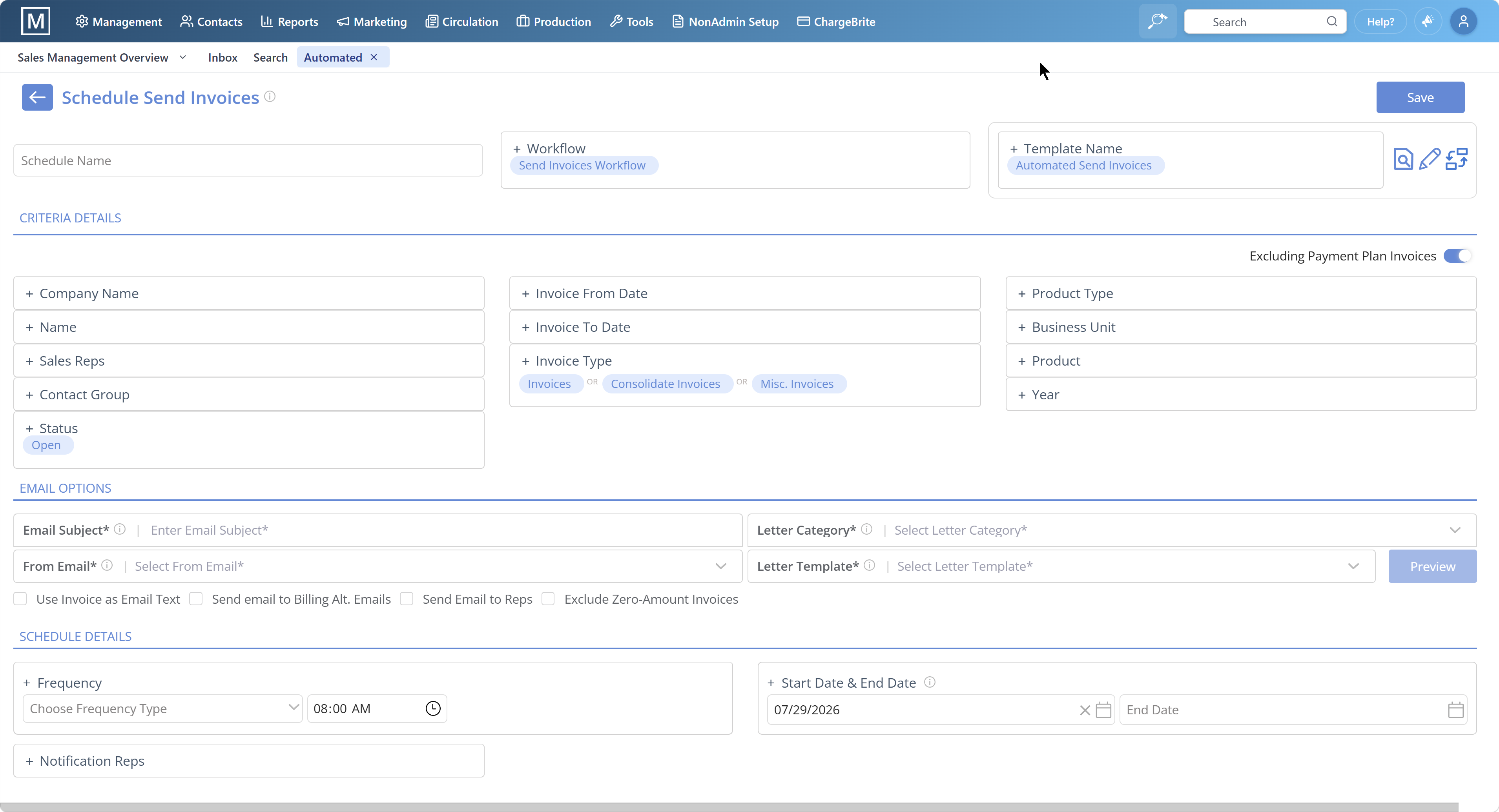
The Magazine Manager delivers invoices electronically through client-facing portals that allow advertisers to review, approve, and pay without phone calls or paper. Advertisers can upload their own creative assets and settle outstanding balances at any time through the portal, reducing the back-and-forth that delays payment and freeing your billing team from manual follow-up. Learn more about the full billing and invoicing automation capabilities.
Payments collected through The Magazine Manager are applied directly to the corresponding invoice records, updating your accounts-receivable ledger in real time. There is no separate reconciliation step between your billing system and your payment processor — the connection is native, keeping your AR current without manual bank-statement matching.
Agency accounts in The Magazine Manager carry commission rate configurations that apply automatically when invoices are generated for agency-placed business. Gross billing, commission deduction, and net due are calculated and displayed on the invoice without manual arithmetic, reducing the discrepancies that cause agencies to short-pay or dispute invoices.
The Magazine Manager integrates natively with QuickBooks and Xero, pushing invoice data and pulling payment confirmations without manual reconciliation. Your finance team works from accounting records that stay current with your publishing CRM, eliminating the dual-entry workflows that introduce errors and slow month-end close.
Digital tearsheets are generated and delivered automatically when an issue closes, giving advertisers immediate proof that their ad ran as contracted. This documentation is attached to the invoice record, so if a payment dispute arises, your team can produce proof of performance instantly rather than searching through archived print copies.
The market for electronic invoicing software is large, but most of it was built for general business — not for publishers managing insertion orders, agency commission splits, and issue-cycle billing. A handful of platforms have been purpose-built for advertising-based media businesses, and the differences in how they approach the contract-to-cash workflow are significant for publishers evaluating their options.
The Magazine Manager is the world's leading magazine CRM, serving more than 33,000 media properties worldwide and rated 4.8 overall on Capterra across 347 verified reviews. Its billing engine is built directly into the same platform that manages ad orders, production, and CRM — so invoices are generated from confirmed order records, not re-keyed from a separate system. Agency commission tracking, digital tearsheet delivery, QuickBooks and Xero integration, and installment billing are all native capabilities. For subscription revenue, ChargeBrite — Mirabel's integrated recurring-billing platform — handles renewal cycles, dunning, and failed-payment recovery within the same environment. Publishers manage both advertising and subscription invoicing without switching systems or reconciling across disconnected tools. On Capterra, The Magazine Manager leads all publishing platforms on overall satisfaction (4.8), ease of use (4.5), and functionality (4.6).
Other platforms in this space vary considerably in how deeply their invoicing workflows are connected to the publishing lifecycle. Some focus primarily on order-to-invoice linkage, generating billing documents directly from finalized ad orders to reduce manual re-entry. Others emphasize payment flexibility — supporting ACH transfers and auto-recurring billing alongside standard card processing — which can meaningfully reduce processing costs on large advertising contracts. Enterprise-oriented options tend to broaden their scope to cover editorial, circulation, and financial accounting in a single environment, though that breadth can come with added implementation complexity and longer onboarding timelines.
For most magazine publishers — particularly those managing multi-issue ad contracts, agency relationships, and subscription revenue alongside advertising — the key differentiator is not whether a platform can generate an invoice, but whether it can generate the right invoice automatically from a confirmed order record, apply the correct commission and discount rules, and connect that invoice to both the production workflow and the accounting system without manual handoffs. That is the standard against which publisher-specific platforms should be evaluated.
Before selecting an invoicing platform, publishers can assess their own billing complexity across five dimensions. The higher the score, the more a purpose-built publishing platform outperforms a general CRM:
Multi-issue contracts — Do you regularly sell contracts spanning three or more issues? (1 point each for 3–5 issues, 2 points for 6+)
Agency volume — What share of your ad revenue flows through media buying agencies? (1 point for under 25%, 2 points for 25–50%, 3 points for over 50%)
Channel mix — Do you bill across print, digital, and events simultaneously? (1 point per active channel beyond one)
Co-op billing — Do any advertisers require co-op-compliant invoice documentation? (2 points if yes)
Subscription revenue — Do you manage both advertising and subscription billing? (2 points if yes)
A score of 5 or above indicates that a general-purpose CRM will require significant customization to handle your billing workflows reliably.
A score of 8 or above indicates that the implementation and maintenance cost of adapting a general CRM will likely exceed the cost of a purpose-built publishing platform within the first year.
Platform Evaluation Guide
Why the platform you choose as your invoicing foundation shapes every billing workflow downstream
The comparison below captures the most operationally significant differences for a publisher evaluating these categories.
When publishers evaluate invoicing software, two broad categories emerge: general-purpose CRM and sales platforms like HubSpot and Salesforce, and purpose-built publishing platforms like The Magazine Manager. On the surface, both manage contacts, track deals, and can generate documents. But the moment a publisher needs to bill for a fractional page, apply a frequency discount across a multi-issue contract, or reconcile ad orders against production schedules, the differences become consequential.
HubSpot is a capable marketing and sales CRM built for a broad commercial audience. It was not designed with publishing or media billing in mind. It has no native ad order management, no contract-to-cash workflows tailored to publication cycles, and no built-in mechanisms for the rate-card complexity that magazine and media billing routinely demands. Publishers who attempt to use HubSpot as an invoicing foundation typically face one of two paths: extensive custom development to approximate publishing-specific logic, or a patchwork of third-party integrations that add cost, maintenance burden, and data fragmentation.
Salesforce is a powerful enterprise CRM with a broad ecosystem of add-ons and a highly configurable data model. Like HubSpot, however, it was built for general commercial sales workflows, not media billing. Publishers using Salesforce typically require significant custom development or third-party media-specific apps to handle insertion orders, issue-based billing, and agency commission tracking. The platform's flexibility is genuine, but that flexibility comes with implementation complexity and ongoing configuration costs that purpose-built alternatives avoid entirely.
Purpose-built platforms, by contrast, are architected around the realities of publishing revenue — insertion orders, issue-based billing, advertiser aging reports, and the tight link between sold space and production workflow. These capabilities exist natively, without customization, because the platform was designed from the ground up for media companies.
Electronic invoicing refers to a structured, automated process in which invoice data is generated directly from your order management system and transmitted to the buyer through a digital channel that provides delivery confirmation, receipt tracking, and payment integration. Emailing a PDF is a manual step that requires someone to create the document, attach it, and send it — with no guarantee the recipient received or opened it. True e-invoicing eliminates those manual steps and connects the invoice to the payment workflow automatically.
Yes, when the platform is built for publishing. The Magazine Manager allows you to configure agency commission rates at the account level. When an invoice is generated for agency-placed business, the system calculates gross billing, applies the commission deduction, and displays the net amount due — without manual arithmetic. This prevents the discrepancies that cause agencies to short-pay.
In The Magazine Manager, invoicing is linked directly to the ad order and production record. When an issue closes and ads are confirmed as run, the billing trigger fires from the production status — not from a separate manual step. This means you only invoice for ads that actually ran, and the invoice details match the production record exactly, reducing disputes.
Electronic invoicing platforms that integrate with ad management allow you to attach proof of performance — digital tearsheets, signed insertion orders, delivery confirmations — directly to the invoice record. When a dispute arises, your team can produce this documentation immediately rather than searching through archived files. Disputes are resolved against the original order record, cutting resolution time significantly.
Yes. The Magazine Manager integrates natively with QuickBooks and Xero, pushing invoice data and pulling payment confirmations without manual reconciliation. Your accounting records stay current with your publishing CRM, eliminating the dual-entry workflows that introduce errors and slow month-end close.
Advertising billing is triggered by confirmed ad placements and tied to insertion orders, issue dates, and agency commission structures. Subscription billing is time-based, driven by renewal cycles, auto-renew flags, and dunning sequences for failed payments. The Magazine Manager handles both within the same platform — advertising invoices flow from the ad order workflow, while subscription billing is managed through ChargeBrite, Mirabel's integrated subscription and recurring billing platform.
ChargeBrite is Mirabel Technologies' subscription-automation and recurring-billing platform, built directly into The Magazine Manager. It handles recurring billing, payment retries, dunning, and renewal reminders for subscription revenue — so publishers manage both advertising and subscription invoicing within one connected system rather than maintaining separate tools for each revenue stream.
The clearest indicators are a high volume of invoice disputes, an AR aging report with significant balances past 60 days, staff time spent manually reconciling payments against invoices, and frequent discrepancies between what was sold and what was billed. If your billing team regularly re-enters data from ad orders into a separate invoicing tool, or if your accounting software requires a manual export from your publishing system, those handoffs are where errors and delays accumulate. An integrated publishing platform eliminates each of those friction points.
What Publishers Say
We've been with Magazine Manager for over 8 years. Their digital tearsheets feature alone SAVED ME over $9,000 a year by not having to buy stamps, envelopes, paper, toner, or pay a staff member to stuff envelopes with invoices.
we are able to quickly and easily pull targeted email lists to generate sales, electronically invoice clients in literally minutes, take payments, and with a click of a button know what our clients' ad schedules are, what they have paid and what they owe.
One of the things that is helpful about The Magazine Manager is the comprehensive ability to keep customer and client records and to invoice people directly through the program. On a daily basis, I utilize the search functions and functionality. Through Magazine Manager, I find it helpful to use functions such as sales reports, the A/R Aging Summary, and other features.
The Magazine Manager serves more than 33,000 media properties worldwide and is rated 4.8 out of 5 on Capterra based on 350+ verified reviews. It is the only magazine CRM built from the ground up for the full publishing workflow — from ad sales and production through invoicing and payment reconciliation.