Publishing Workflow Efficiency
Redundant data entry, disconnected systems, and manual hand-offs are quietly draining your team's time and your publication's revenue.
If your sales team re-enters an advertiser's contact details into three different systems, your production team chases insertion orders that already exist in a spreadsheet somewhere, and your billing team reconciles invoices against records that don't match what ad ops logged — you are not alone, and you are not imagining the cost. For magazine publishers, duplicate work is rarely visible as a single line item, yet it compounds across every department, every issue cycle, and every client relationship. The Magazine Manager is built specifically to close these gaps, unifying CRM, ad management, production, and billing into one connected workflow so that information entered once flows everywhere it needs to go.

In publishing, duplicate work rarely announces itself. It hides inside routines that feel normal — the spreadsheet a sales rep updates after closing a deal, the email a production coordinator sends to confirm ad specs, the invoice an accounting staffer manually keys in at month's end. Each step seems reasonable in isolation. Together, they represent the same information being entered, re-entered, and re-entered again across disconnected systems.
Here is what that cycle looks like in practice. A sales rep closes an ad deal and records it in a CRM or, more commonly, a personal spreadsheet. That record then gets manually transcribed into a production system so the layout team knows what space to reserve and what materials to expect. Once the issue closes, the same deal details are typed a third time into a billing platform to generate an invoice. If anything changes along the way — a size upgrade, a revised insertion date, a cancelled position — every one of those entries must be tracked down and corrected individually. Miss one, and the production team builds a page around an ad that no longer exists, or accounting invoices for a rate the client never agreed to.
This is duplicate work in a publishing operation: the manual transfer of the same data point across multiple, siloed tools that do not communicate with each other. It is not a productivity problem caused by slow employees. It is a structural problem caused by workflows that were never designed to share information.
The downstream costs compound quickly. Errors introduced during re-entry create billing disputes that delay revenue. Production teams waste hours chasing confirmation on details that were already captured at the point of sale. Sales reps spend time on data entry instead of prospecting. And because no single system holds the authoritative version of a deal's status, managers lose visibility into what has actually been sold, produced, and billed at any given moment.
Recognizing duplicate work means asking a direct question about every handoff in your workflow: is someone retyping information that already exists somewhere else? If the answer is yes, that is where the hidden cost lives.
Duplicate work in publishing is not evenly distributed. It concentrates in four specific areas of the operation, each of which interacts with the others — meaning an error or delay in one department cascades into the next.
The sales department is typically where a deal's data is first captured, and it is also where the most re-entry originates. When a rep closes an order, that information must travel to production, billing, and sometimes audience development. In operations without a unified platform, each of those transfers is manual. Reps who spend meaningful time on data entry are reps who are not prospecting, following up on proposals, or calling on renewal accounts. The opportunity cost is direct and measurable.
Production coordinators are among the most frequent victims of duplicate-work systems. Their job requires knowing exactly what has been sold, to whom, at what specifications, and by which deadline — information that originates in the sales department but must somehow reach them reliably. In disconnected operations, that handoff is typically an email, a shared spreadsheet, or a verbal briefing. Each of those channels introduces interpretation risk. A coordinator who spends hours each week chasing ad specifications that were already captured at point of sale is a coordinator who is not building layouts, managing editorial schedules, or developing the publication.
Billing is where duplicate-entry errors become financially visible. An invoice generated from a manually re-keyed record carries every error introduced upstream. A mistyped rate, a missing discount, or a wrong insertion date becomes a billing dispute — and resolving that dispute pulls in the sales rep, an ad operations contact, and an accounting staffer, each of whom must trace the error back through whichever system they own. The investigation time is not recoverable, and the relationship friction it creates is real.
Subscription and circulation teams face their own version of the problem. When subscriber records live in a separate platform from advertiser and CRM data, running a renewal campaign or a targeted upsell requires exporting lists from one system and importing them into another. Every export-import cycle is a data-sync risk: contacts that have changed status, updated their preferences, or lapsed since the last export may not reflect accurately in the destination system. Audience teams working from stale or mismatched data make decisions — and send communications — based on a version of reality that no longer exists.
Most publishing teams are familiar with the children's game of telephone — a message whispered from person to person arrives at the end of the chain barely resembling the original. The same phenomenon plays out every day inside disconnected publishing workflows, except the stakes are real: lost revenue, missed deadlines, and damaged advertiser relationships.
It starts simply enough. A sales rep closes a deal and records the advertiser's specs, run dates, and pricing in a spreadsheet or a standalone CRM. That information then gets re-keyed by a billing coordinator into an invoicing system. A production manager reads the email thread, pulls what they need, and enters it again into a layout tool. Each time a human being reinterprets and retypes data from one system into another, a new opportunity for error is introduced.
The compounding effect is what makes this so damaging. A transposed digit in an ad size becomes a file request sent to the wrong dimensions. A misread insertion date becomes a missed issue. A pricing figure entered without the agreed-upon discount becomes an invoice dispute that takes three email threads and two phone calls to resolve. None of these errors are the result of carelessness — they are the predictable outcome of a workflow that was never designed to share information reliably.
Publishing is particularly vulnerable because a single ad order touches so many departments: sales, billing, production, and circulation can all need access to the same core record at different stages of the workflow.
The multi-department nature of ad fulfillment multiplies error exposure at every stage.
The deeper problem is that errors discovered late in the process are exponentially more expensive to fix than errors caught at the source. A wrong run date flagged before an issue goes to print is an inconvenience. The same error discovered after the issue ships is a make-good, a credit, and a conversation with an unhappy advertiser. Every unnecessary handoff is not just a duplication of effort — it is a loaded risk that compounds with each re-entry.
There is a well-documented principle in data quality research that the cost of fixing an error grows dramatically the longer it goes undetected. An error caught at the moment of entry is far cheaper to correct than one that survives into reconciliation. And if it reaches an advertiser — in the form of a disputed invoice, an incorrect rate, or a misapplied insertion — the cost jumps significantly once you factor in staff time, credit adjustments, relationship repair, and the risk of a lost renewal.
For publishers, this cost curve maps directly onto the ad sales to production to billing handoff chain that most publishing operations run through disconnected systems. A rep closes a deal and enters the order into a CRM. That order then has to be manually described to production — a second entry. Production confirms the placement, and accounting must re-enter the details a third time to generate an invoice. Each translation is a new opportunity for a rate to be mistyped, a run date to shift by a week, or a contracted discount to disappear entirely.
In a publishing environment where a single advertiser may have a multi-insertion contract spanning print, digital, and newsletter placements, a single miskeyed line item can cascade across every subsequent invoice in that contract. By the time an advertiser flags the discrepancy — often at month-end or on renewal — the error has already compounded across multiple billing cycles.
The financial exposure is compounded by the human cost. Resolving an advertiser billing dispute typically pulls in the sales rep, an ad operations contact, and someone from accounting, each of whom must trace the error back through whichever system they own. That investigation time is not recoverable, and the relationship friction it creates is real. Advertisers who experience repeated billing errors are less likely to renew, and the revenue impact of a lost renewal dwarfs the cost of the original mistake many times over.
The structural fix is not better proofreading. It is eliminating the re-entry steps where errors are introduced in the first place. When a finalized order automatically generates an invoice — with data flowing directly from the confirmed order into billing without a manual handoff — the error never has a second or third opportunity to appear.
Most publishing teams frame duplicate data entry as an annoyance. The more accurate frame is opportunity cost — specifically, the selling time, editorial capacity, and employee goodwill that your business loses to work that should not exist.
A sales rep spending hours each week on re-entry is a sales rep spending fewer hours prospecting, following up on proposals, and closing renewals. At even a modest close rate, that reclaimed time represents a meaningful revenue gap — one that compounds every quarter.
The problem is structural, not behavioral. In a typical disconnected publishing operation, a sold ad must be manually described to production after the sale closes, then described again to accounting for invoicing. Each handoff is a fresh opportunity for error and a guaranteed duplication of effort. The data does not flow — it gets retyped, reformatted, and re-explained at every departmental boundary.
The editorial side of the house faces the same pressure. When production coordinators spend hours reconciling ad specifications that were already captured at point of sale, they are not building layouts, refining content schedules, or developing audience products. And employees who experience burnout from repetitive data tasks are not disengaged — they are exhausted by work that should not exist in the first place. In lean publishing teams where replacing a single experienced coordinator or billing manager can cost months of productivity, burnout-driven turnover is among the most expensive consequences of a fragmented workflow.
Quantifying what re-entry actually costs a publishing team requires looking beyond payroll. It requires counting the proposals not sent, the renewals not called, the editorial projects not started, and the experienced staff members who quietly decide the job is no longer worth it.

Consider a mid-size regional magazine running four issues a year with a sales team of three reps. Before consolidation: a rep closes an ad deal and enters it into a spreadsheet. A production coordinator reads the spreadsheet and re-enters placement details into a layout brief. An accounts receivable staffer reads the brief and creates an invoice in a separate accounting tool. Three entry points, three opportunities for the data to diverge.
A billing dispute arises because the invoice reflects the original rate, not the revised rate agreed two days before close. Resolving it takes time-consuming back-and-forth email. Multiply that by a handful of disputes per issue cycle and the hidden cost becomes concrete — not counting the sales productivity lost while reps field billing questions instead of prospecting.
After consolidating onto a unified platform: the rep enters the order once. Production sees it immediately. The invoice generates from the confirmed order. The revised rate is in the record because it was updated there, not in a parallel document. The dispute does not happen.
Ask almost any publishing team whether duplicate data entry is a problem and the answer is immediate: yes. Ask whether they have done anything about it and the answer is usually more complicated. The gap between recognizing the problem and acting on it is one of the most consistent patterns in publishing operations — and it has a specific set of causes worth naming.
The first is normalization. When a workflow has existed long enough, it stops feeling like a problem and starts feeling like the job. A production coordinator who has spent three years chasing ad specs via email does not experience that as waste — she experiences it as her role. The cost is invisible precisely because it has been absorbed into the definition of normal work.
The second is the switching cost illusion. Publishers who have built their operations around a combination of spreadsheets, a general-purpose CRM, and a standalone billing tool often overestimate how difficult it would be to consolidate. The assumption is that migration means months of disruption, lost data, and a team that has to relearn everything at once. In practice, purpose-built publishing platforms are designed to migrate existing advertiser lists, rate cards, and recurring contracts — and most publishers are operational on a unified system far faster than they expect.
The third is the measurement gap. Many publishing operations do not track how much time their teams spend on data transfer tasks, which means the cost of the status quo is never formally quantified. You cannot make a business case for change when the problem has no number attached to it. The audit questions in this article — where does each handoff happen, who re-enters what, and how often does a billing dispute trace back to a transcription error — are the starting point for building that number.
The fourth is a misplaced faith in process discipline. Some publishers respond to duplicate-entry problems by adding checkpoints: a second person reviews the invoice before it goes out, a coordinator confirms specs by phone before production begins. These controls reduce error rates at the margins but do not eliminate the underlying re-entry. They add labor to a broken workflow rather than fixing the workflow itself. The structural answer is not more oversight of manual handoffs — it is fewer manual handoffs.
Recognizing these patterns is the first step toward acting on them. The cost of inaction is not static: as issue volume grows, as teams expand, and as advertiser relationships become more complex, the compounding effect of duplicate work grows with it.
One platform. One record. Data entered once and carried automatically through every stage of your operation.
Duplicate entry is not a people problem — it is a systems problem. When your CRM, ad management, production, billing, and subscription tools are separate applications, every handoff between departments becomes an opportunity for data to be re-keyed, mistyped, or lost entirely. The Magazine Manager was built from the ground up to close those gaps by keeping every module inside a single, connected platform.
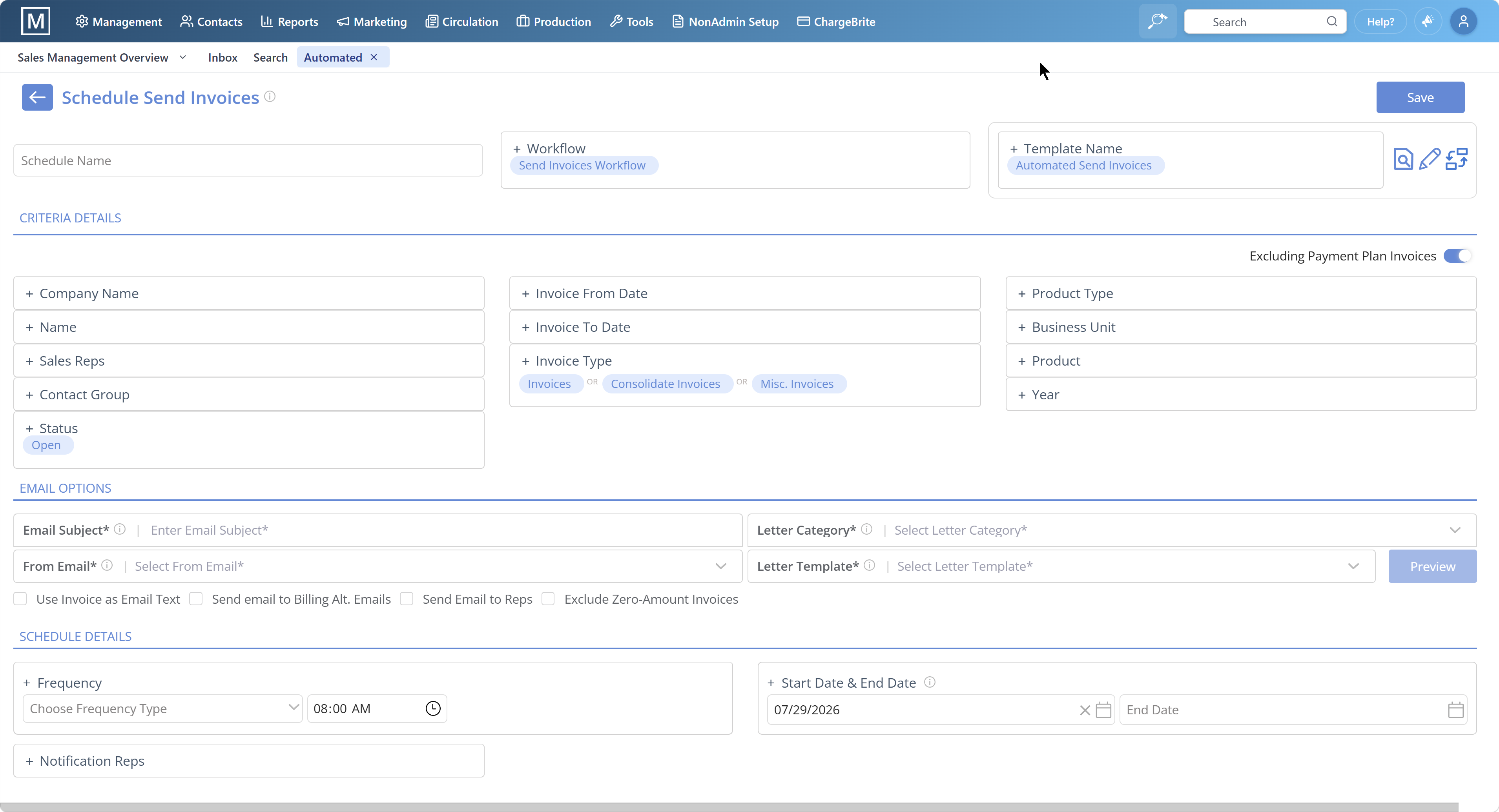
When a new advertiser is added to the publishing CRM, that contact record does not stay isolated. It flows immediately into ad order management, so sales reps can attach orders, track proposals, and log activity against the same record — no copy-pasting company names, addresses, or contact details into a separate system. When an ad order is confirmed, the production team sees it automatically, with all specifications and deadlines already attached. There is no email chain required to hand off the brief, and no second entry of issue dates or placement details.
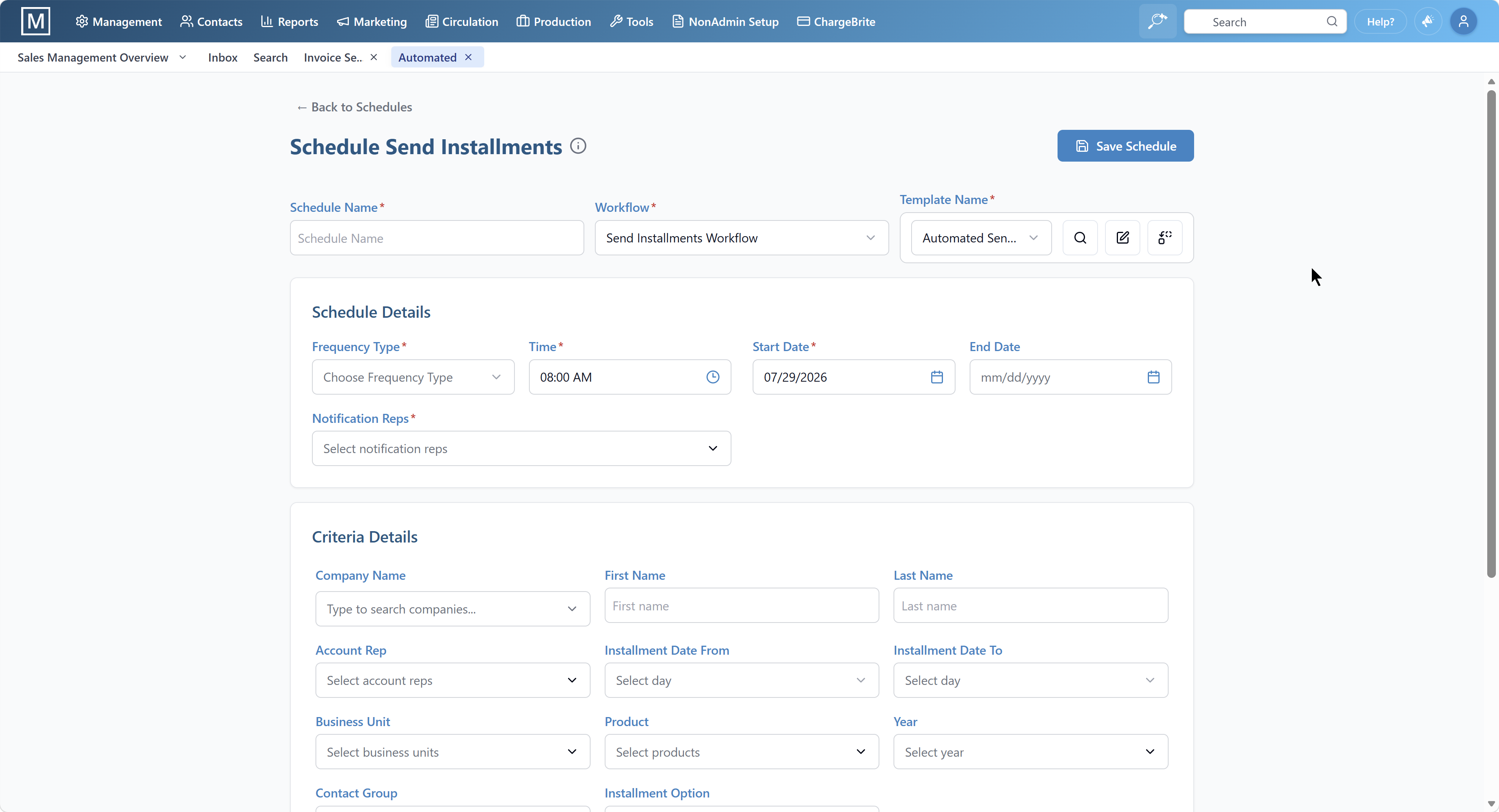
On the billing side, ChargeBrite — Mirabel Technologies' recurring-billing platform built directly into The Magazine Manager — means that invoice data originates from the confirmed order, not from a separate spreadsheet or accounting application. Subscriber revenue, payments, and renewal status flow back into the CRM so that sales, audience, and finance teams all read from the same source of truth. Auto-renewals, dunning sequences, and payment confirmations fire without manual intervention, removing an entire category of repetitive administrative work. Publishers dealing with billing disputes find that a single order-to-invoice record eliminates the version-control problem that causes those disputes in the first place.
Subscription management follows the same principle. Whether a publisher sells print-only, digital-only, or bundled plans, subscriber records live inside The Magazine Manager alongside advertiser and prospect data. Audience development teams do not need to export lists from one system and import them into another to run a renewal campaign — the data is already there.
Marketing automation through Mirabel's Marketing Manager extends this further. Because CRM data, subscription records, and website visitor history all live in one place, teams can build highly targeted mailing lists and trigger campaigns based on real behavior — without moving between platforms or reconciling mismatched records. The result is meaningful: time your ad sales reps previously spent on re-entry gets redirected to selling. See how that shift affects sales productivity in practice.
Every advertiser, prospect, and subscriber record lives in one place. Contact details, activity history, and account status are entered once and referenced across every other module — sales, production, billing, and marketing — without re-entry. Unlike general-purpose CRMs, the data model is built around publishing objects: insertion orders, placements, issue schedules, and billing cycles. Explore the publishing CRM.
When a sales rep confirms an ad order in the CRM, production teams see it immediately with all placement details, specifications, and deadlines already attached. No email handoffs, no duplicate data entry, no risk of spec errors introduced during re-keying. The same record that closed the sale drives the production task.
ChargeBrite, built directly into The Magazine Manager, generates invoices from confirmed ad orders and subscription plans. Payments, renewals, and revenue data flow back into the CRM automatically, giving finance and sales a shared, reconciliation-ready view — without the manual export-import cycle that plagues publishers using separate billing tools. Explore publishing billing and invoicing features.
Print, digital, and bundled subscriber records sit alongside advertiser data in one system. Auto-renewals, failed-payment recovery, and self-service portals run without manual intervention, eliminating the repetitive administrative work that consumes audience development teams and the data-sync errors that arise when subscriber lists live in a separate platform.
Mirabel's Marketing Manager draws on CRM records, subscription status, and website visitor history to build targeted lists and trigger campaigns — all without exporting data to a separate email platform or reconciling out-of-sync contact lists. All contact properties are sourced from the same live data that sales and billing already use.
CRM Limitations Unpacked
A sales CRM fixes one layer — but publishing duplicate work lives in three more
HubSpot and Salesforce are genuinely capable platforms for what they were built to do: manage contacts, track deals, and keep a sales pipeline organized. For general sales teams, either platform can be enough.
For a publishing operation, neither comes close to solving the duplicate-work problem.
The core issue is architectural. Both HubSpot and Salesforce organize the world around the contact or account as the primary object. Publishing, however, organizes around relationships between advertisers, agencies, insertion orders, ad placements, production schedules, and billing cycles. None of those objects exist natively in either platform. The moment a confirmed ad sale needs to move from the CRM into ad operations, production, or accounts receivable, a staff member must re-enter it somewhere else — and that re-entry is precisely where duplicate work is born.
This means HubSpot and Salesforce do not eliminate duplicate data entry in publishing. They relocate it. The sales record lives in the CRM; the insertion order lives in a spreadsheet or a separate ad management tool; the invoice lives in an accounting package. Three systems, three entry points, three opportunities for the same information to diverge. The billing and invoicing gap alone is responsible for a significant share of publisher billing disputes — because the invoice is generated from a document that is already one step removed from the original order record. Publishers looking to reduce billing errors find that no amount of process discipline fully compensates for a disconnected data model.
The problem compounds when publishers try to bridge these CRMs with other platforms. Syncing a general-purpose CRM with a second system creates data-model mismatches — contact-first versus account-first structures — that can generate duplicate records and broken reporting in both systems. Resolving those duplicates requires manual review and merging on both sides, which doubles the remediation effort rather than reducing it.
Duplicates that persist across systems also skew analytics. When the same advertiser appears under two slightly different names across your CRM and your billing tool, revenue reports undercount your best clients and distort renewal forecasting. Strategic decisions — which verticals to grow, which accounts to prioritize — get made on flawed data. The downstream effect on sales productivity is real: reps spend time reconciling conflicting records instead of selling.
The Magazine Manager is built differently. Ad sales, insertion orders, production scheduling, and billing all live inside a single data model, so information entered at the point of sale flows automatically into every downstream workflow. There is no second system to re-enter it into, and no sync to maintain. For a full comparison of how a purpose-built publishing CRM differs from a general-purpose platform, see the publishing CRM overview.
Understanding the problem in the abstract is useful. Identifying exactly where it lives in your own operation is what makes change possible. The following questions are designed to surface the specific handoff points where duplicate entry is costing your team time and accuracy.
At the point of sale: When a rep closes an ad deal, where does that information go first? Is it entered into a CRM, a spreadsheet, or an email? How many other people or systems need to receive that same information before the issue closes? See how a purpose-built ad order management workflow eliminates that first re-entry point.
At the production handoff: How does your production team learn what has been sold? Do they receive a formal brief, an email summary, or access to the same system the sales team uses? If they receive a brief or email, who writes it — and are they retyping information that already exists in a sales record? A connected production workflow automation tool makes that retyping unnecessary.
At billing: How does your accounting team know what to invoice? Do they generate invoices from confirmed order records, or do they work from a separate document — a spreadsheet, a PDF, or an email summary — that someone else prepared? How often do billing disputes arise from information that changed between the sale and the invoice? Publishers who consolidate here see the largest immediate impact; explore publishing billing and invoicing features and how to reduce billing errors.
At subscription renewal: When your audience development team runs a renewal campaign, where does the subscriber list come from? Is it exported from a subscription platform and imported into an email tool? How recently was that export made, and how confident are you that lapsed or upgraded subscribers are accurately reflected?
Across departments: Is there a single system that multiple departments — sales, production, billing, and audience — can access to see the current status of an advertiser or subscriber account? Or does each department maintain its own version of that record? A unified publishing CRM is the architectural answer to that question.
If any of these questions reveal a manual transfer step — a re-keying, an export, a forwarded email — that is a duplicate-work risk point. The goal of a unified publishing platform is to make those transfer steps unnecessary by keeping all departments reading from and writing to the same underlying record.
Not every duplicate-work problem costs the same. When deciding where to start, rank your fixes in this order:
Billing errors and disputes Highest Impact
A billing discrepancy that delays payment or triggers a dispute can hold up revenue for weeks. When invoice data is re-keyed from a sales record into a separate accounting tool, version drift is almost inevitable — rates change, placements shift, and the invoice reflects an earlier snapshot. Fixing this first protects cash flow directly. Start with billing and invoicing and error reduction.
Production handoffs Medium-High Impact
A missed spec or wrong placement discovered at proof stage costs press time and, in some cases, a reprint or a make-good. Connecting the confirmed sale directly to the production workflow removes the brief-writing step and the transcription errors that come with it.
Subscription data sync Medium Impact
Stale subscriber lists inflate unsubscribe rates, waste campaign spend, and undercount your active audience. Fixing the export-import cycle between your subscription platform and your email tool is lower urgency than billing but compounds over time as list quality degrades.
Magazine Manager is specifically designed for those of us in the print and digital publishing industry and it is crucial to our sales success. It is extremely easy to learn and apply immediately. With this software, we are able to quickly and easily pull targeted email lists to generate sales, electronically invoice clients in literally minutes, take payments, and with a click of a button know what our clients' ad schedules are, what they have paid and what they owe. ... As a past Salesforce user, this is SO much easier to use and because it is made for ad sales, the company deeply understands the details of exactly what we need from this software.
The Magazine Manager is tailored to our industry and they are always looking for ways to get more from the data so I can make informed decisions on the progress of our publications. With the CRM, billing, and production modules everyone uses the same software making it much easier for everyone to do their job.
I've tried all the major CRMs but for the publishing industry, no one does it better than Magazine Manager. It streamlines the sales process with integrated tools. Everything works together!
Common Questions
The cost is easier to calculate than most publishers expect. Research consistently shows that employees in data-intensive roles spend a significant portion of their week transferring information between systems — time that carries a real labor cost and compounds through the errors it introduces. A simple model illustrates the scale: even a few minutes of duplicate entry per transaction, multiplied across a team and an issue cycle, adds up to meaningful direct labor expense before accounting for billing disputes and the staff time required to resolve them. The less visible cost is opportunity cost: every hour an ad sales rep spends re-entering data is an hour not spent prospecting or closing.
The highest-frequency duplicate-entry points in publishing follow the order lifecycle: advertiser onboarding (contact details entered into a CRM, then re-entered into an ad management tool), proposal to contract (deal terms recorded in one system, then re-keyed into an order form), production handoff (confirmed order details transcribed into a layout brief or email), billing (invoice created from a separate document rather than the confirmed order record), and subscription renewal (subscriber list exported from one platform and imported into an email tool). Each of these handoffs is a re-entry event — and each one introduces a new opportunity for the data to diverge from the original.
General-purpose CRMs like Salesforce and HubSpot are built around contacts and accounts as their primary objects. Publishing workflows are built around insertion orders, placements, production schedules, and billing cycles — none of which exist natively in those platforms. The Magazine Manager's data model is built specifically for publishing, so an ad order entered at the point of sale automatically flows into production and billing without any re-entry. There is no second system to update and no sync to maintain.
ChargeBrite is Mirabel Technologies' subscription-automation and recurring-billing platform, built directly into The Magazine Manager. Because it operates inside the same platform as your CRM and ad management tools, invoice data originates from confirmed orders rather than being re-keyed into a separate billing application. Subscriber revenue, payments, and renewal status flow back into the CRM automatically, so sales, audience, and finance teams all work from one source of truth.
Yes — multi-title management is a core capability. Each title gets its own editorial calendar, sales pipeline, and reporting, while cross-title roll-up at the publisher level is built in. Advertisers can have a single annual contract that runs across multiple titles, with all order and billing data unified in one record.
When a sales rep confirms an ad order, production teams see it immediately inside the same platform — with all placement details, specifications, and deadlines already attached. There is no separate brief to write, no email to send, and no risk of spec errors introduced during re-keying. The record that closed the sale is the same record that drives the production task.
Dedicated onboarding migrates your existing advertiser list, recurring contracts, rate cards, and subscriber database. The migration team has moved publishers off all major CRMs and standalone billing tools, and the process is designed to minimize disruption to active issue cycles.
Yes. The Magazine Manager integrates natively with QuickBooks and Xero, pushing invoices and pulling payments without manual reconciliation. This closes the loop between ad billing and financial reporting without requiring a separate data-entry step in your accounting system.
Subscriber records live inside The Magazine Manager alongside advertiser and CRM data. Renewal campaigns, dunning sequences, and audience segmentation all draw from the same live records — there is no export-import cycle required to move subscriber lists into a separate email platform. When a subscriber's status changes, every department sees the updated record immediately.
See how The Magazine Manager unifies your publishing operation and eliminates the re-entry that is quietly costing your team time and revenue.