The Magazine Manager — World’s Leading Magazine Software
Stop leaving money on the table — here is how a purpose-built CRM turns your publishing operation into a revenue engine
Most magazine publishers already know a CRM tracks contacts. What fewer realize is that a CRM built specifically for publishing — one that connects ad sales, billing, production, and audience data in a single platform — can actively drive new revenue rather than simply record it. The Magazine Manager, the world’s leading magazine software, is designed to do exactly that. This article breaks down seven concrete, revenue-specific ways an integrated CRM like The Magazine Manager helps publishers close more deals, reduce revenue leakage, and grow recurring income across print, digital, and event channels.
Most conversations about CRM software for magazine publishers start in the wrong place. They focus on tidier contact records, cleaner pipelines, and fewer sticky notes on monitors. Those are real benefits, but they undersell the actual business case by a wide margin. The more accurate frame is revenue integration — treating your CRM not as a filing cabinet but as the connective tissue between every dollar your publication earns and every system that touches it.
Consider what happens when your CRM, billing system, ad management platform, and production workflow operate as separate islands. A sales rep closes a deal at a negotiated rate, but that rate never makes it cleanly into the billing system. The invoice goes out at the wrong figure. Your finance team spends hours reconciling the discrepancy. Meanwhile, a renewal deadline passes unnoticed because no one system owned the reminder. That advertiser quietly moves budget elsewhere.
Billing errors, unauthorized discounts, and missed renewal windows represent a consistent, measurable revenue leak for publishers who rely on disconnected tools.
Billing errors tied to manual data hand-offs, unauthorized discounts that never get flagged, and missed renewal windows represent a consistent, measurable revenue leak for publishers who rely on disconnected tools. Add the staff hours consumed by reconciliation overhead — cross-checking ad orders against invoices, chasing down approval chains for rate exceptions — and the cost of not integrating compounds quickly.
Revenue integration flips this dynamic. When your CRM carries a sales opportunity all the way through to a posted invoice, a production order, and a renewal alert without requiring a human to re-key data at each handoff, the system itself becomes a revenue protection mechanism. Discounts require documented approval. Renewals trigger automatically. Billing reflects what was actually sold.
The Magazine Manager is built around exactly this principle — connecting CRM, billing, ad management, and production into a single workflow so that the path from prospect to paid invoice has no gaps where revenue can silently disappear.

Magazine publishing continues to grow — but only operators with integrated infrastructure are positioned to capture that growth.
The magazine publishing industry continues to expand, with digital publishing software and subscription management platforms among the fastest-growing segments. Growth at that pace compresses the window for publishers still running fragmented stacks of disconnected design, billing, CRM, and distribution tools.
Fragmentation is not just inconvenient — it is expensive. Every hour spent reconciling data across siloed systems is an hour not spent closing ad deals, reducing churn, or identifying upsell opportunities. Digital ad management and proof-of-performance reporting are now considered essential, not optional, by advertisers. Publishers who cannot deliver them risk losing campaigns to competitors who can.
The competitive window is real and narrowing. Publishers who unify their revenue operations — connecting ad sales, subscription management, invoicing, and reporting inside a single integrated CRM — are building structural advantages that compound over time. Those still stitching together workarounds absorb reconciliation overhead that quietly erodes margin. The seven strategies below show exactly where integrated CRM systems convert that operational advantage into measurable revenue.
Revenue leakage rarely shows up as a single dramatic loss. It accumulates quietly — a 10% discount here, a complimentary added placement there, a rate a sales rep quietly adjusted to close a deal before month-end. Across dozens of advertisers and hundreds of insertions, these small concessions compound into significant margin erosion that never appears on any single invoice but devastates annual revenue targets.
The root cause is almost always the same: rate cards that live in spreadsheets, PDFs, or the institutional memory of individual salespeople rather than inside the system that actually generates proposals and contracts. When rate card data is disconnected from the sales workflow, enforcement depends entirely on human discipline — and human discipline is inconsistent under quota pressure.
The Magazine Manager solves this by embedding rate card logic directly into the CRM and ad order workflow. When a sales rep builds a proposal, approved rates for each ad unit, issue, frequency tier, and advertiser category are pulled automatically from a centralized rate card database. The system flags any deviation from approved pricing before the proposal ever reaches the advertiser, routing discount requests through a defined approval chain rather than allowing them to slip through unchecked.
Publishers can configure discount thresholds — for example, allowing reps to offer a small discount without escalation, requiring a sales manager sign-off for larger discounts, and reserving anything beyond that for executive review. Every exception is logged with a timestamp, the rep's name, the justification entered, and the approver's decision. That audit trail transforms discount management from a reactive conversation into a proactive data set.
When reps know that every rate deviation is visible and documented, the frequency of speculative discounting drops. When managers can see which accounts consistently receive exceptions, they can identify whether the issue is a pricing problem, a training gap, or a client relationship that needs renegotiation. For publishers running multiple titles or selling across print and digital simultaneously, centralized rate card enforcement through The Magazine Manager also ensures consistency across the portfolio — so the same advertiser cannot receive dramatically different treatment depending on which rep or which brand they happen to call first.
Unsold ad space is one of the most preventable revenue leaks in magazine publishing. When your sales pipeline lives in a spreadsheet or a disconnected CRM, your team has no real-time view of which pages, positions, or digital placements are still available — and which are quietly aging toward the print deadline. The result is a familiar pattern: last-minute scrambles, steep rate discounts to fill space, and revenue that should have been secured weeks earlier.
The Magazine Manager ties your sales pipeline directly to your actual ad inventory — both print and digital. Every opportunity in the pipeline is mapped to a specific placement, issue, or digital unit. Sales reps can see at a glance what is reserved, what is in negotiation, and what remains open. Ad directors get a live utilization view across issues and editions without chasing status updates from the team.
This pipeline-to-inventory connection changes how your team prioritizes outreach. Instead of working a generic prospect list, reps can focus on filling the placements most at risk of going unsold. If a full-page spread in a high-value position is still unbooked weeks from close, the system surfaces that gap so the team can act at full rate rather than discovering it at the deadline when the only lever left is a discount.
The integrated approach also prevents double-booking and the awkward client conversations that follow. Because inventory is updated in real time as proposals are created and contracts are signed, two reps cannot unknowingly pitch the same position to competing advertisers. For digital inventory, the same logic applies across ad units, newsletter placements, and sponsored content slots. Publishers managing both print and digital revenue streams can view utilization across all channels in a single dashboard, making it far easier to bundle placements into multi-platform packages — a proven strategy for increasing average deal size without adding headcount.
When your team can see exactly what needs to be sold and how much time remains, they sell proactively rather than reactively. Fewer pages go unsold, fewer deals close below rate card, and your revenue forecast becomes a reliable number rather than an optimistic guess.
Subscription revenue is the financial backbone of most magazine publishers, yet a surprising share of it quietly disappears not because readers lost interest, but because no one reminded them to renew at the right moment. Manual renewal campaigns — spreadsheets, batch emails sent once a quarter, phone calls made too late — leave money on the table. The Magazine Manager closes that gap by automating the entire renewal lifecycle from first notice to final save attempt.
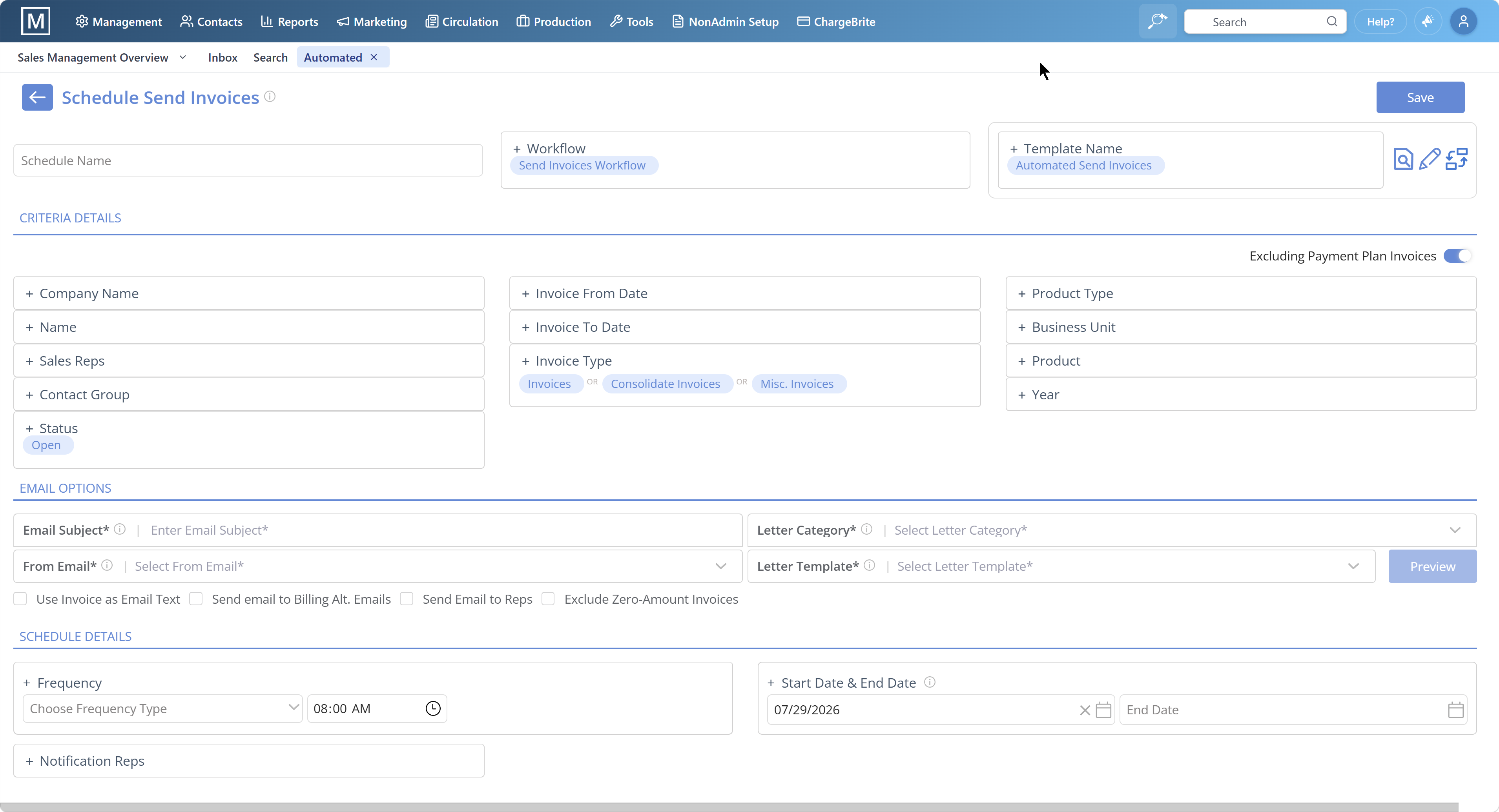
The process starts well before a subscription expires. Publishers can configure multi-step renewal sequences that trigger automatically based on each subscriber's expiration date — a first reminder at 90 days, a second at 60, a third at 30, and a final urgent notice at 7 days, each personalized with the subscriber's name, their specific subscription tier, and a direct renewal link. Because these sequences run inside the same system that holds billing and subscription data, every touchpoint reflects real account information rather than generic messaging.
Churn-risk signals can also be surfaced. Rather than treating every subscriber identically, The Magazine Manager can surface accounts that show warning signs — lapsed engagement or a failed payment attempt. Publishers can route high-risk subscribers into a separate, higher-touch outreach track: a personal call from a circulation rep, a loyalty offer, or a survey to understand why they are considering leaving. Acting on risk signals weeks before expiration is far more effective than trying to win back a subscriber who has already lapsed.
When a payment does fail, ChargeBrite — Mirabel Technologies' subscription-billing engine built directly into The Magazine Manager — retries the card on a defined schedule, sends payment-update requests to the subscriber, and supports a card-account-updater feature that refreshes expired cards automatically, recovering involuntary churn without staff intervention.
Every percentage point improvement in renewal rate compounds across the full subscriber base. Publishers using The Magazine Manager gain a clear view of renewal performance through built-in reporting, so circulation teams can see which sequences convert best, which segments churn most, and where to refine their approach.
For magazine publishers, the gap between closing an ad sale and actually receiving payment is where cash flow quietly bleeds out. Sales reps finalize orders, but invoices get queued behind manual data entry, approval chains, and accounting handoffs. By the time a bill reaches an advertiser, days — sometimes weeks — have already passed. Multiply that lag across dozens of active accounts and you have a days-sales-outstanding problem that no amount of new business can fully offset.
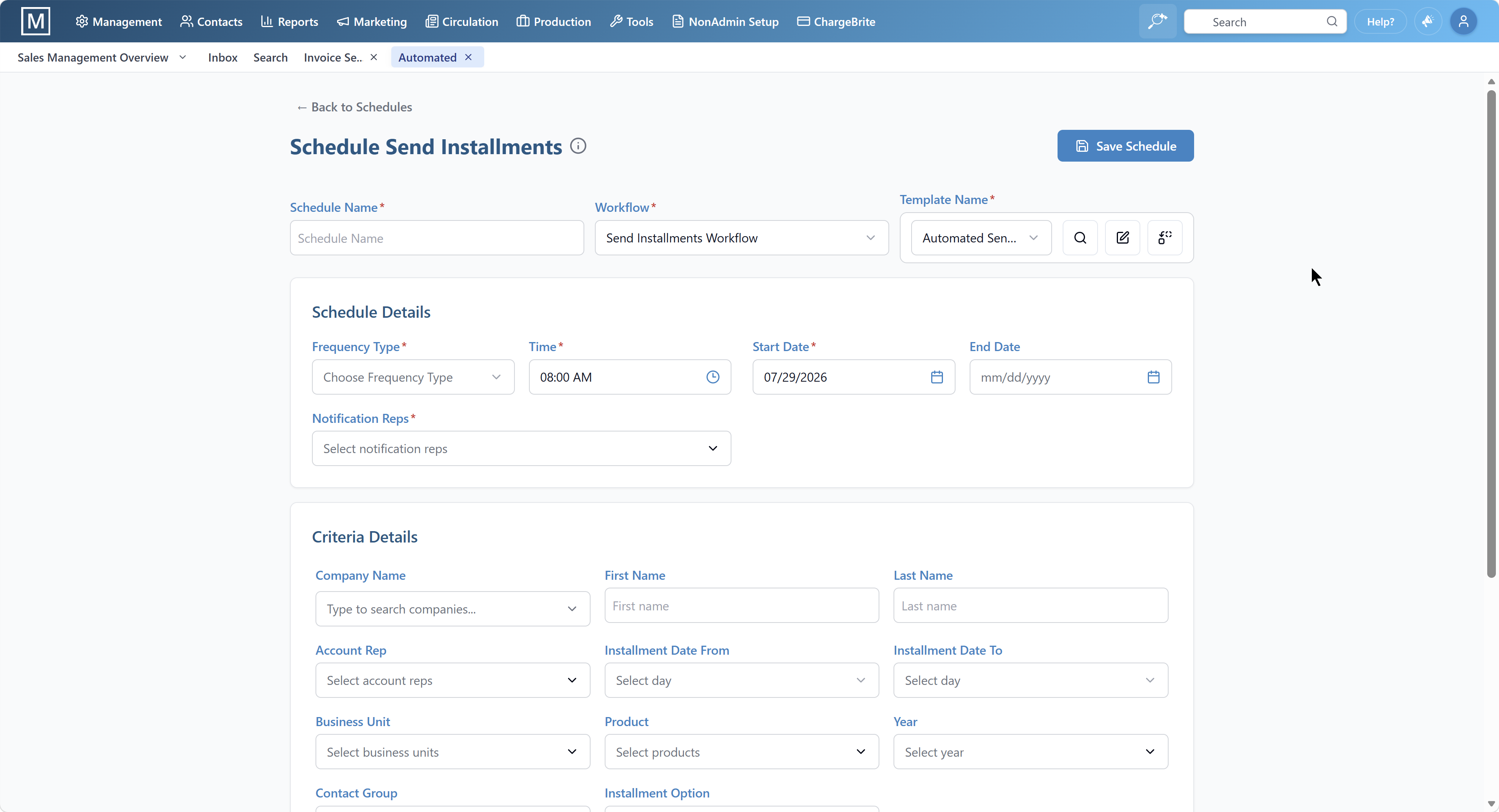
The Magazine Manager addresses this directly by automating invoice generation the moment an order is finalized. Rather than waiting for a billing clerk to pull order details and build an invoice from scratch, the system creates and dispatches the invoice automatically, pulling line items, rates, issue dates, and contract terms directly from the confirmed order record. The advertiser receives an accurate bill quickly after the sale closes.
Verified Capterra reviewers of The Magazine Manager highlight how fast this workflow is in practice. Lisa B. noted the ability to "electronically invoice clients in literally minutes" and take payments without leaving the platform.
Mary L. calculated that digital tearsheets — which replace paper invoices entirely — "SAVED ME over $9,000 a year by not having to buy stamps, envelopes, paper, toner, or pay a staff member to stuff envelopes with invoices."
The Magazine Manager supports ACH payment processing, allowing advertisers to pay electronically without mailing checks or manually initiating wire transfers. ACH transactions settle faster than paper checks and eliminate the float time that inflates days-sales-outstanding figures. For publishers running recurring campaigns — annual contracts, multi-issue schedules, or digital edition packages — the system handles recurring billing cycles automatically, charging the agreed amount on the agreed date without manual intervention each period.
Follow-up reminders for outstanding balances can also be automated, so your team is not spending hours each week tracking down late payments by phone or email. The system flags aging receivables and triggers reminder sequences on a schedule you define, keeping pressure on overdue accounts without pulling staff away from revenue-generating work. Shorter invoice-to-payment cycles mean more predictable cash on hand, reduced reliance on credit lines to cover operational gaps, and a finance team that spends its time on analysis rather than data entry.
Native integrations with QuickBooks and Xero mean that every invoice created in The Magazine Manager flows directly into your accounting system, and payments pulled from those platforms reconcile automatically — eliminating the manual export-and-import cycle that introduces errors and delays in most disconnected publishing stacks.
Most magazine publishers operate with fragmented data. The sales rep handling print advertising has no visibility into whether that same advertiser just renewed a digital sponsorship. The events team does not know which print clients skipped last year's conference. The subscription team cannot see which loyal readers have never been approached about advertising packages. Each team works from a partial picture, and the revenue gaps between those partial pictures are where upsell and cross-sell opportunities quietly disappear.
The Magazine Manager eliminates that fragmentation by consolidating print ad orders, digital ad campaigns, event sponsorships, and subscription records into a single client profile. When every revenue stream feeds the same system, patterns that were previously invisible become obvious and actionable.
Consider what that looks like in practice. A sales rep opens a client record and immediately sees that the advertiser has run full-page print ads for three consecutive issues, has never purchased a digital banner, and attended your industry summit as a general attendee rather than a sponsor. That combination — consistent print spend, zero digital footprint, event engagement — is a textbook cross-sell moment. Without a unified CRM, assembling that picture manually would require pulling reports from three separate systems, assuming anyone thought to look in the first place.
The Magazine Manager surfaces these moments because the data lives together. Sales teams can filter their entire book of business by criteria like print-only clients above a certain spend threshold, lapsed event sponsors, or subscribers who have never been contacted about advertising. These filtered views become prospecting lists that drive proactive outreach rather than reactive order-taking.
Upsell opportunities are equally visible. When a client's ad schedule shows they consistently book half-page placements and their category competitors are running full-page spreads, that gap is a conversation waiting to happen.
When a digital advertiser's campaign metrics show strong engagement but they have no print presence, the data makes the upgrade pitch nearly self-evident.
Beyond individual deals, the consolidated view helps editorial and sales leadership identify which revenue combinations produce the highest lifetime client value. Publishers who bundle print, digital, and event packages consistently see stronger retention than those selling each product in isolation — and understanding which clients are missing pieces of that bundle is only possible when all the data lives in one place.
For publishers managing multiple titles, The Magazine Manager's multi-title architecture means a client's activity across every brand in the portfolio is visible from a single account record. An advertiser who runs campaigns in two of your five titles but has never been approached about the other three represents a straightforward expansion conversation — one that is only possible when cross-title data is unified rather than siloed by publication.
For most magazine publishers, the traditional direct-sales model has a built-in ceiling. Every new advertiser requires a sales rep to prospect, pitch, negotiate, and close — a process that works well for premium accounts but makes smaller, local, and category-adjacent advertisers economically difficult to pursue at scale. Programmatic advertising opens a parallel channel that captures demand your direct sales team cannot cost-effectively reach.
When your CRM connects to programmatic demand sources, ad inventory that would otherwise go unsold — remnant digital placements, lower-tier newsletter slots, off-peak digital editions — becomes accessible to a broader pool of advertisers through automated buying. The CRM captures impression data and revenue, updates inventory in real time, and routes reporting back to the same dashboards your sales team uses for direct campaigns. The result is a revenue stream that runs alongside your direct sales motion without requiring additional headcount to manage.
The operational leverage here is significant. Your existing sales team stays focused on high-value direct relationships where personal selling justifies the investment. Programmatic handles the inventory that would otherwise age toward the deadline unsold, generating incremental revenue at low marginal cost.
For publishers running digital editions, newsletters, or sponsored content alongside print, programmatic also accelerates fill rates on digital inventory without forcing your reps to spend time on low-yield placements. Inventory that would never justify a full sales cycle still contributes to total revenue — improving overall yield across your digital portfolio.
The broader principle applies to publishers of every scale: connecting your CRM to programmatic demand channels expands the total revenue your publication can capture without expanding your cost base. Direct sales and programmatic are not competing strategies — they are complementary channels, each optimized for a different segment of the advertiser market, both feeding into the same integrated revenue picture.
When advertisers can see exactly what their spend delivered, renewals become easier and budget conversations shift in your favor
The single biggest obstacle to growing advertiser relationships is not price — it is proof. When a brand manager asks what their campaign actually delivered, a publisher who can only point to a print tearsheet and a rough digital impression count is at a serious disadvantage. A publisher running The Magazine Manager can pull a unified performance view that spans print insertions, digital display, sponsored email, and event sponsorships — all attributed to the same advertiser record and presented in one coherent view.
This matters because advertisers today allocate budgets across channels simultaneously. If your reporting treats each channel as a separate silo, you force the buyer to do the synthesis work themselves, and they will often conclude the results are inconclusive. Cross-channel reporting inside a single CRM eliminates that friction. A media sales rep can walk into a renewal meeting with a document showing that an advertiser's full-page print placement, banner campaign, and conference sponsorship collectively reached a specific audience segment, generated measurable engagement, and delivered a cost-per-touch that compares favorably to their other media buys.
The Magazine Manager connects ad order data, billing history, production status, and digital delivery metrics within the same platform. That means your team is not manually reconciling spreadsheets from three different systems the night before a client meeting. The data is already consolidated, already tied to the correct advertiser account, and already formatted for a conversation about next year's investment rather than last year's receipts.
The platform's reporting capabilities extend beyond individual client reviews. Sales leadership can build custom dashboards that surface revenue by channel, by title, by rep, and by advertiser category — giving executives the real-time visibility they need to make informed decisions about where to invest sales resources and which revenue streams are underperforming relative to their potential. Hundreds of configurable data tiles mean each team sees the metrics most relevant to their role without wading through irrelevant data.
Publishers who present this kind of structured performance evidence consistently report stronger renewal rates and a higher rate of advertisers expanding their packages. When you remove doubt about what a campaign accomplished, the advertiser's default position shifts from skepticism to confidence — and confidence leads to larger commitments.
Cross-channel reporting also gives your sales team a competitive differentiator when prospecting. Showing a potential advertiser a sample performance report that integrates print, digital, and events signals organizational sophistication and accountability that many competitors simply cannot match. In a media landscape where every dollar is scrutinized, that transparency is not just a nice feature — it is a revenue strategy.
HubSpot and Salesforce are powerful platforms — but powerful for whom? Here is what publishers actually encounter when they try to run ad sales and revenue workflows through a general-purpose CRM.
HubSpot has earned its reputation as a strong platform for inbound marketing, subscriber lifecycle tracking, and email campaigns. For a digital-first publisher whose revenue model centers on audience growth and newsletter monetization, it offers a credible foundation.
But magazine publishers do not run on audience growth alone. They run on ad sales pipelines, insertion orders, print production schedules, rate cards, and billing cycles tied to issue dates — none of which HubSpot was built to handle natively. The gaps in native media sales and ad revenue management are not minor. They represent the core of how most magazine publishers actually generate revenue.
Salesforce occupies a different tier of the general-purpose CRM market — enterprise-grade pipeline management, deep customization, and a vast ecosystem of add-ons. For large publishing groups with dedicated administrators and development resources, it can be configured to approximate publishing workflows. But that configuration is the operative word: insertion orders, issue-based inventory, and rate card enforcement are not native features. They are custom builds that require ongoing maintenance and specialist knowledge to sustain. The result is a platform that can technically do the job but demands significant investment before it speaks the language of magazine ad sales.
To approximate what a publishing-native platform delivers out of the box, a HubSpot or Salesforce user must source, configure, and maintain third-party integrations for ad server connectivity, paywall management, and print workflow coordination. That integration overhead translates directly into delayed time-to-revenue and ongoing maintenance costs that compound as the tech stack grows.
Publishing-native platforms like The Magazine Manager are architected around the opposite assumption: that ad sales, billing, production, and CRM are not separate problems requiring separate tools, but a single integrated workflow. Insertion orders, rate cards, issue-based billing, and advertiser relationship tracking exist as first-class features rather than workarounds. Revenue workflows that require weeks of HubSpot or Salesforce configuration are available on day one. For teams selling print, digital, and event sponsorships simultaneously, that alignment is not a convenience — it is a measurable competitive advantage in how quickly deals close and how accurately revenue gets tracked.
"Magazine Manager is specifically designed for those of us in the print and digital publishing industry and it is crucial to our sales success. It is extremely easy to learn and apply immediately. With this software, we are able to quickly and easily pull targeted email lists to generate sales, electronically invoice clients in literally minutes, take payments, and with a click of a button know what our clients' ad schedules are, what they have paid and what they owe. As a past Salesforce user, this is SO much easier to use and because it is made for ad sales, the company deeply understands the details of exactly what we need from this software."
"I've tried all the major CRMs but for the publishing industry, no one does it better than Magazine Manager."
"I honestly can't imagine doing my job both as a sales representative and as owner of our publication/website without having Magazine Manager as a tool. And we've only invested in a portion of their features. I could easily see us expanding our commitment with them as we grow in the future."
The Magazine Manager is a publishing CRM platform built specifically for magazine publishers. It includes ad sales CRM, billing and subscription management, production and layout tools, and reporting — all in a single integrated system designed to automate publishing workflows.
The Magazine Manager includes ChargeBrite, Mirabel Technologies' subscription-billing engine, which automates renewals, recurring billing, dunning, and payment recovery. Auto-renewal fires invoices and charges on the cadence each subscription specifies, with renewal reminders sent in advance. Subscribers can update payment details through a self-service portal.
Yes. The platform supports print-only, digital-only, and bundled subscriptions, plus memberships, gift subscriptions, and add-ons. Monthly, quarterly, and annual billing cadences are all supported.
ChargeBrite's smart dunning automatically retries failed cards on an optimized schedule, sends branded payment-update reminders, and supports a card-account-updater feature so expired cards refresh without subscriber action. Most failed payments are recovered before the subscriber ever lapses.
Yes. Subscription revenue, payments, and churn data flow into The Magazine Manager so your sales, audience, and finance teams work from one source of truth. ChargeBrite also simplifies accounting and taxes with reconciliation-ready reporting.
Yes — multi-title support is core to the platform. Each title gets its own editorial calendar, sales pipeline, and reporting. Cross-title roll-up at the publisher level is built in. Advertisers can have one annual contract that runs across multiple titles.
Issue confirmation triggers tearsheets and invoices automatically. Native QuickBooks and Xero integrations push invoices and pull payments without manual reconciliation.
Because The Magazine Manager consolidates print ad orders, digital campaigns, event sponsorships, and subscription records into a single client profile, sales teams can immediately see which revenue streams a client is not yet using. Filtered views of the client database — for example, print-only advertisers above a certain spend threshold — become ready-made prospecting lists for cross-sell outreach without any manual report-building.
Pricing depends on the number of titles, users, and modules you enable. Book a free demo for exact numbers — no contracts to sign before you see the price.
The Magazine Manager is rated 4.8 out of 5 on Capterra with 352 verified reviews, making it one of the most highly rated publishing platforms available. Join thousands of publishers who have replaced disconnected tools with a single integrated system.