
Everyone’s favorite parlor game — “That’s Gotta Be AI, Right?” — has finally been adopted by resourceful researchers who can put in the blood, sweat, and tears to get the answer.
In analyzing the text of 10,000 webpages this past summer, the Pew Research Center found that 10% show “significant signs of AI authorship,” though that hardly tells the whole story.
“One-in-ten webpages as of July 2026 may seem modest,” write the researchers, “but the internet includes a mix of new and old material. A lot of pages in these random samples couldn’t have been written by AI. If we filter old webpages out of our samples and look at only the pages published after the release of ChatGPT, the trend is even more pronounced.”
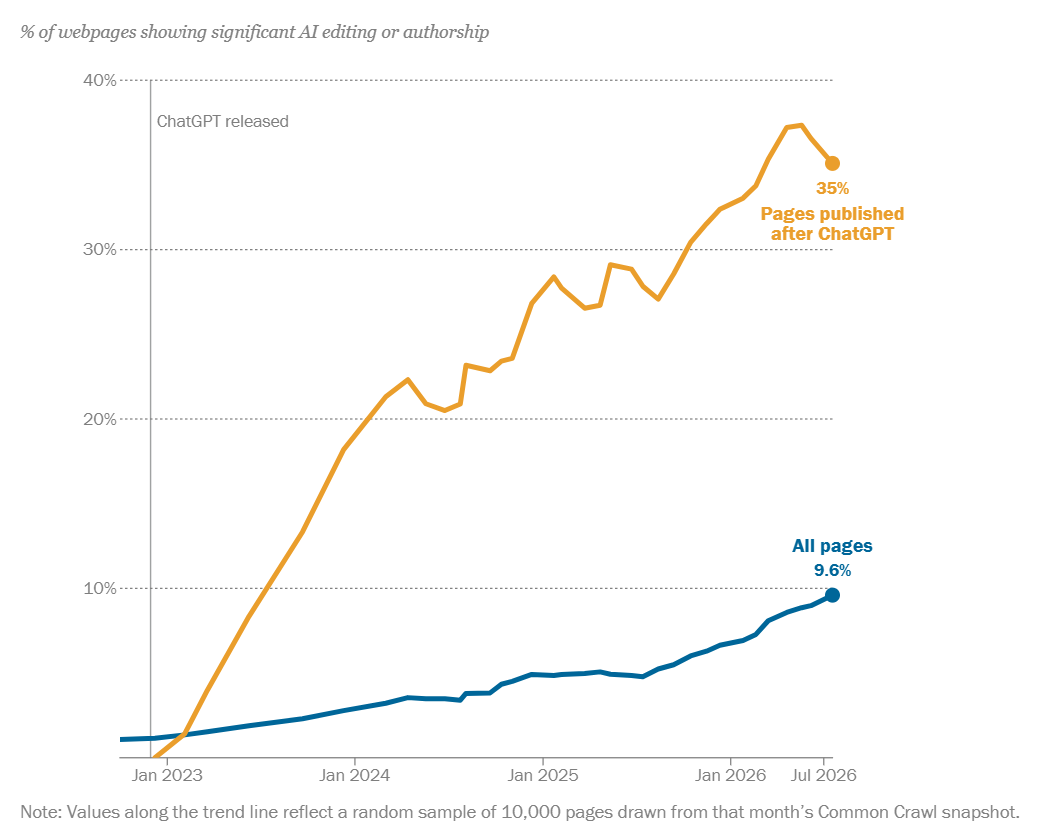
(Photo Source: Pew Research Center)
In fact, 35% of pages published in the post-ChatGPT era show strong AI signs, with common features of that AI-generated content being em-dashes and oxford commas. Both punctuation examples, as the Pew research highlights, have long been used extensively by journalists and academic writers — to say nothing of humble human blog writers who may have used those punctuations in the first paragraph of this very blog — and their inclusion in such large training datasets have clearly left specific marks on AI models.
“Comparing the internet of today to a snapshot from 2023,” the research says, “em dashes appear about twice as frequently, Oxford commas see a 63% increase, [and] certain words that AI models like to use (such as ‘delve,’ ‘interplay’ or ‘testament’) have more than doubled in usage.”