
Last week, I wrote about Google’s recent steps to pay publishers for content the Big Tech company uses in its AI-generated responses.
Shortly before that announcement last month, researchers from the University of Pennsylvania and Northeastern University published their findings on Google’s AI search features, confirming realities that publishers know all too well that, as Search Engine Journal puts it, “directly contradict Google’s assertions that people love AI search and that it is sending more traffic than ever.”
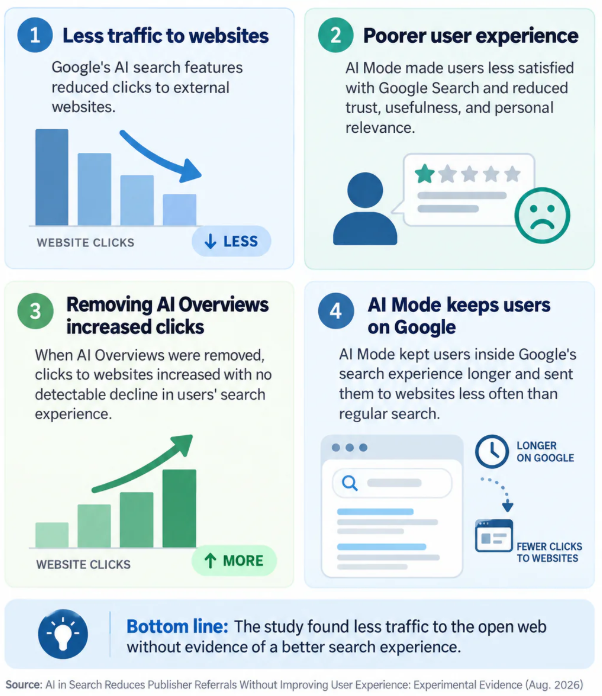
“AI in Search Reduces Publisher Referrals Without Improving User Experience: Experimental Evidence” (Photo Source: Search Engine Journal)
“In a preregistered randomized controlled trial with participants using Google Search in their everyday browsing, we find that removing AI features in Google Search increases clicks to third-party publishers, while Google’s conversational AI search reduces clicks and worsens user experience,” says the researchers behind the study, entitled “AI in Search Reduces Publisher Referrals Without Improving User Experience: Experimental Evidence.”
And while many of the figures are densely cluttered amongst study-specific trials and terminologies, the general takeaway is crystal-clear.
“If users remain firm in their mistrust and dislike of AI Mode, Google will face a tension between pushing the product on users (to acclimate them as much as for its other benefits), and risking alienation that could cost it ground to competitors in a search market that today is nearly monopolistic,” the study says. “Given these implications, high stakes for Google, publishers, and users alike, we argue that AI-mediated search should be evaluated not only in terms of the quality of answers generated, but also in terms of how these systems reshape the relationship between users, publishers, and the broader web — from the sustainability of publishers, to Google’s status as an intermediary, to users’ own right to control their discovery, evaluation, and engagement with with information.”