From fragmented tools to a single, seamless publishing platform — the operational shift redefining how magazines grow.
Today's magazine publishers are caught between rising advertiser expectations, tighter production deadlines, and the relentless pressure to do more with smaller teams. For years, the default answer was to bolt together a patchwork of disconnected tools — a CRM here, a billing system there, a separate ad trafficking platform, and yet another solution for layout and production. The result is data scattered across systems, staff toggling between logins, and revenue falling through the cracks every time a handoff goes wrong.
The defining operational shift of this publishing era is consolidation. Publishers who once accepted fragmentation as an unavoidable cost of doing business are now demanding a single platform that connects every workflow — from the first advertiser conversation to the final printed page. All-in-one magazine management software eliminates the integration tax, reduces human error, and gives every department a shared view of the business in real time.
In this article, we examine why publishers are making the switch, what to look for in a unified platform, and how solutions like The Magazine Manager — purpose-built for media companies and serving more than 33,000 media properties worldwide — are helping publishers automate workflows, accelerate billing cycles, and reclaim the hours once spent reconciling data between tools. Whether you run a regional trade title or a multi-brand media group, the case for consolidation has never been stronger.
The hidden operational cost of managing your publishing business across disconnected systems compounds with every issue cycle.
Picture a Monday morning at a mid-size magazine publisher. The sales team opens their standalone CRM to log a new advertiser conversation. The billing department is in a separate accounting platform, chasing down an invoice that was manually re-entered from a deal closed two weeks ago. Meanwhile, the production team is working from a spreadsheet — or a shared folder of files — trying to figure out which ads have been approved, which are still awaiting creative, and which issue pages are actually ready to close.
This is not a worst-case scenario. For most publishers still running a fragmented software stack, this is Tuesday. And Wednesday. And every deadline week.
The problem starts with how publishing operations grew. Teams adopted tools one at a time, solving immediate pain points without a view of the whole workflow. A CRM was added to manage advertiser relationships. A separate invoicing tool handled billing. A project management app tracked production tasks. Email threads and spreadsheets filled the gaps between all of them. Each tool made sense in isolation. Together, they create a system where data lives in silos, handoffs require manual re-entry, and no single person — or screen — can tell you the true status of a campaign from sold to printed.
The hidden costs compound quickly. When a sales rep closes a deal, someone else must manually transfer that information into billing. When billing updates a payment status, production has no automatic way to know. When an advertiser calls to ask about their ad placement, the account manager has to check three different places before giving an answer — if they can give one at all. Each of these friction points costs time, and time in publishing is measured in deadlines.
There is also the cost of errors that fragmentation makes inevitable. Duplicate data entry means duplicate opportunities for mistakes. An ad spec entered incorrectly in one system does not automatically correct itself in another. A billing discrepancy discovered in month three of a campaign requires tracing back through multiple platforms to find where the breakdown occurred.
Beyond the day-to-day drag, fragmented stacks make it nearly impossible to see your business clearly. When revenue data lives in one tool, advertiser history in another, and production status in a third, building an accurate picture of performance requires manual aggregation — work that is slow, error-prone, and often out of date by the time it is finished. Publishers running this way are not just inefficient. They are operating without the visibility they need to grow.

Publishers who run three, four, or five disconnected tools rarely see the full cost of that fragmentation on a single invoice. The expense is distributed — across hours spent re-entering data, across revenue that slips through when a renewal reminder never fires, across the institutional knowledge that evaporates when a veteran rep leaves and their account notes exist only in a personal inbox.
Consider the reconciliation ritual that plays out at most multi-tool publishers before every issue closes. An ad coordinator exports a spreadsheet from the CRM, cross-references it against the billing platform, flags discrepancies, manually updates the production schedule, and emails finance to confirm that invoices match what actually ran. That process, repeated across every issue cycle, can consume the better part of a full working day per person — time that could be spent selling, creating, or serving subscribers. Publishers using all-in-one platforms report saving meaningful hours per rep per week on administrative tasks alone, simply because data entered once flows automatically to every system that needs it.
Missed renewals represent an equally serious and equally invisible leak. When subscriber records live in one platform and billing triggers live in another, the connection between 'contract expiring' and 'outreach sent' depends on a manual step that is easy to skip during a busy production week. Publishers operating this way risk losing a meaningful share of potential ad revenue to disorganized pipelines, missed renewals, and under-priced inventory — losses that compound across every issue cycle and accelerate whenever a key team member changes.
Then there is the knowledge-transfer risk. A senior advertising sales representative who has managed accounts for years carries critical context: which clients prefer quarterly billing, which have historically upgraded to premium placements, which need a personal call rather than an automated reminder. When that information exists only in their head or in private email threads — rather than in a unified CRM with full account history — their departure creates an immediate revenue vulnerability that no spreadsheet can repair.
The hidden cost of fragmentation is not a technology problem. It is a business continuity problem. Every manual handoff between disconnected systems is a point where data can be lost, delayed, or entered incorrectly — and in publishing, where every issue cycle runs on tight deadlines, those failure points compound faster than most teams realize until they are already behind.
The case for all-in-one software is not that best-of-breed tools are bad. In many cases, a dedicated email platform, a specialist billing engine, or a purpose-built production tool genuinely outperforms the equivalent module inside a unified platform on a feature-by-feature basis. That is the honest version of this debate, and publishers deserve to hear it before they make a decision.
The real question is not which approach wins on features. It is which approach wins on total operational cost — including the integration maintenance, data reconciliation, training overhead, and revenue leakage that accumulate when best-of-breed tools are stitched together.
Best-of-breed stacks tend to work well when the tools involved share clean, reliable integrations and when the workflows between them are simple and infrequent. A marketing team that sends one newsletter per week and reconciles subscriber counts monthly can probably manage a disconnected email tool and CRM without significant pain. But publishing operations are not simple or infrequent. Ad orders change mid-campaign. Billing must reflect those changes immediately. Production needs to know which ads are confirmed before pages can be closed. Renewals must trigger at the right moment based on billing history. Each of these dependencies requires the tools involved to communicate in real time — and real-time integration between best-of-breed tools is expensive to build, fragile to maintain, and rarely as reliable as native connectivity within a single platform.
The integration tax is where best-of-breed stacks quietly lose the comparison. Every API connection between tools requires ongoing maintenance as vendors update their systems.
Every data sync introduces a lag — sometimes hours — during which the two platforms disagree about the state of the business. Every new team member must be trained on multiple interfaces, multiple login credentials, and the specific manual steps required to keep the systems aligned.
For publishers evaluating this trade-off honestly, the question to ask is not 'which individual tool is best at each task?' It is 'what is the total cost — in time, money, and revenue risk — of keeping these tools connected and synchronized across every issue cycle?' For most magazine publishers, that honest accounting tips decisively toward consolidation.

Bottom line for publishers
Native connectivity within a single platform eliminates integration debt — so your team spends less time reconciling data and more time growing revenue.
There is a meaningful difference between software built from the ground up for magazine publishing and a general-purpose CRM that has been stretched, patched, and customized to approximate publishing workflows. That difference shows up every day, in every department, in ways that quietly cost publishers time and money.
A generic CRM is designed around a universal sales pipeline: leads move through stages, deals close, contacts get logged. That model works well for industries where the sale is the endpoint. Publishing is different. The sale of an ad unit is the beginning of a chain of interconnected obligations — an insertion order must be generated, the ad must be placed on a flat plan, creative assets must be tracked and approved, the issue must go to production, and a tearsheet must be delivered to the advertiser after publication. None of those steps exist natively in a general CRM. They are bolted on through custom fields, third-party integrations, manual workarounds, or separate software entirely.
General-purpose CRM and marketing platforms were not designed for publishing-specific workflows. Ad order entry, insertion orders, flat planning, and subscription billing all require significant customization before a publisher can use them effectively. Platforms that offer deep customization options can deliver that flexibility — but it comes at a price: publishers typically need substantial development time and investment before the platform delivers publishing-specific value, building insertion-order logic, renewal tracking, and billing workflows that a publishing-native platform ships on day one. That total cost of ownership can be considerably higher than a purpose-built publishing platform.
A publishing-native platform like The Magazine Manager is architected around the actual sequence of events in a publishing cycle. Insertion orders are not a custom object bolted onto a contact record; they are a core data type that flows directly into flat planning, production tracking, billing, and renewal management. When a rep closes a deal, the flat plan updates. When production confirms an ad ran, billing can invoice and a tearsheet can be generated and delivered — all within the same system.
Renewal tracking illustrates the gap most clearly. In a generic CRM, tracking which advertisers are due for renewal requires custom automation or manual calendar reminders. In a publishing-native platform, renewal intelligence is built into the advertiser record from the moment the first insertion order is created, giving sales teams a proactive view of upcoming opportunities rather than a reactive scramble.
For publishers evaluating software, the question is not whether a generic CRM can be made to handle publishing tasks. With enough customization, it can. The question is whether that customization will ever be as reliable, as fast, or as maintainable as a platform where those workflows were the original design brief.
Every module in The Magazine Manager is designed to work together — so data entered in one part of the platform flows automatically to every other part that needs it.
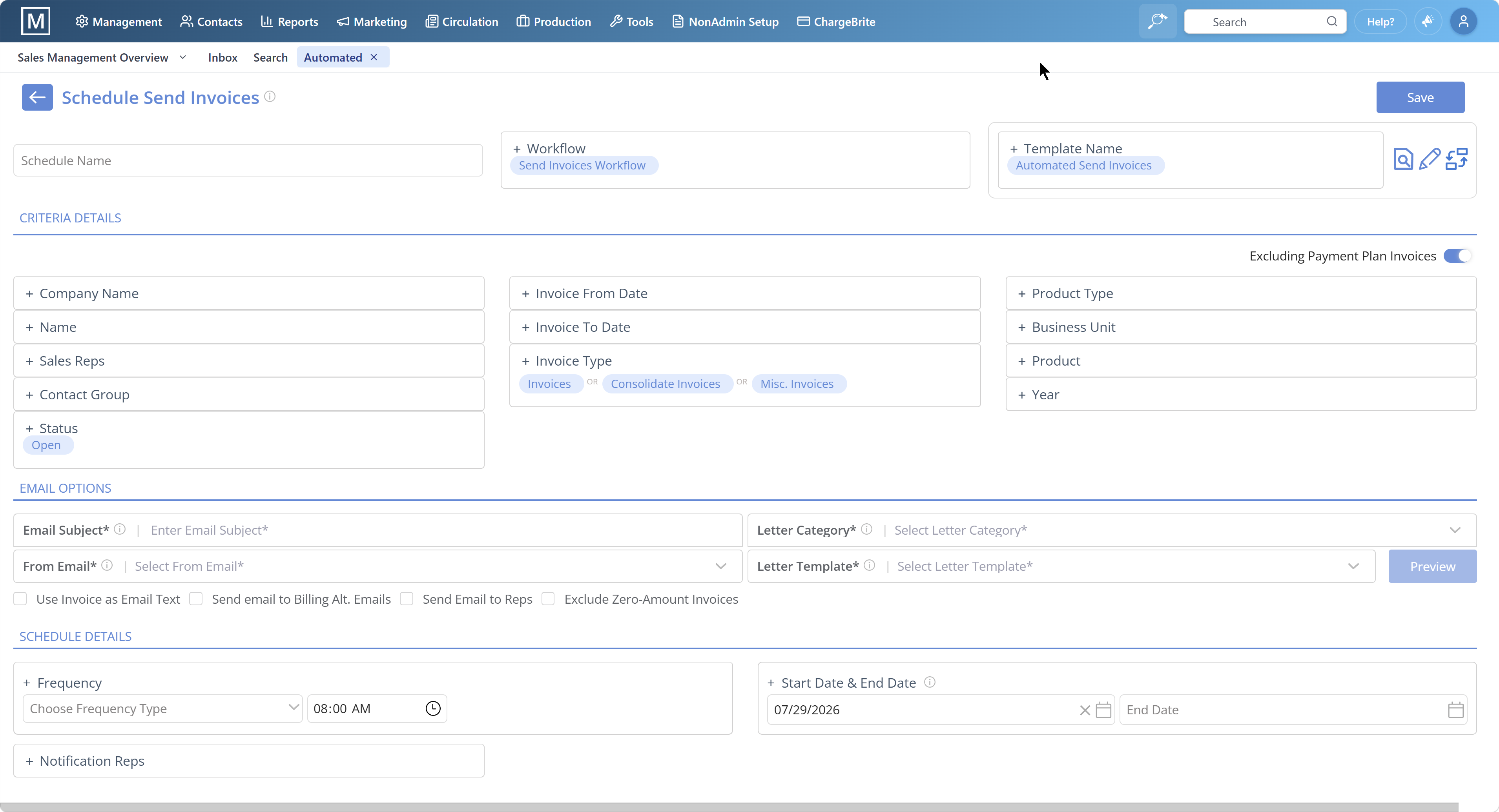
A CRM built specifically for magazine ad sales — with insertion orders, rate cards, recurring contracts, and renewal tracking as native features, not custom fields bolted onto a generic deal model.
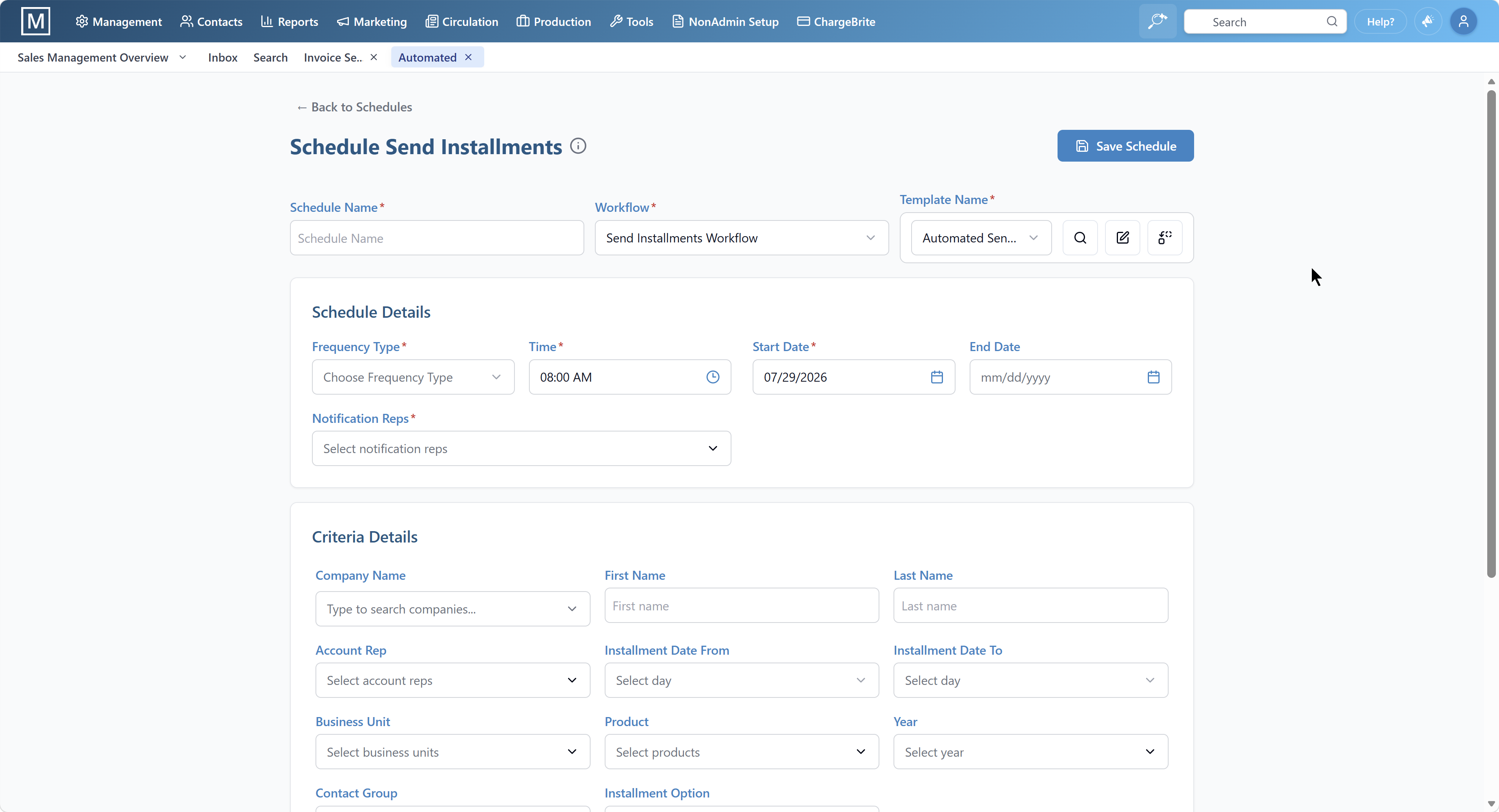
Manage proposals, contracts, ad orders, revisions, invoicing, and fulfillment across print, digital, email, and events — all within a single workflow that connects sales to production to billing.
Automate recurring billing, renewals, dunning, and payment processing through ChargeBrite — Mirabel's integrated subscription and billing platform — with revenue data flowing directly back into the CRM.
Connect confirmed ad orders directly to your production workflow. Creative deadlines, material requirements, and page placement are visible to the production team the moment a deal is signed.
Power targeted campaigns, list segmentation, and marketing automation using live CRM data — without exporting to a separate tool. Build highly targeted mailing lists, run A/B tests, and track campaign performance from within the same platform.
Custom dashboards give leadership real-time visibility into sales performance, revenue forecasting, audience growth, and operational efficiency — across every title and every team.
Not every part of your workflow delivers equal returns when unified. Here is where consolidation pays off fastest.
Publishers running disconnected tools rarely know which integration gaps are costing them the most. The answer lies in tracing where data crosses system boundaries most often — because every handoff is a friction point, and friction compounds into lost revenue and wasted hours.
Four layers define the modern publishing stack, and each responds differently to consolidation.
This is where consolidation delivers the sharpest ROI. When prospect records, proposal history, insertion orders, and follow-up tasks live in separate tools, sales reps spend significant time on administrative reconciliation rather than selling. A unified CRM built specifically for ad sales eliminates duplicate data entry, surfaces pipeline gaps in real time, and keeps every client touchpoint in a single record. Deals close faster when reps can generate a proposal, send a contract, and log a call without switching applications.
Billing is the layer most vulnerable to manual error when it sits apart from ad sales. When an insertion order changes mid-campaign — a common occurrence — disconnected billing systems require someone to manually update invoices, adjust revenue recognition, and notify finance. Consolidating order management with billing means rate changes, cancellations, and makegoods flow through automatically, reducing invoice disputes and accelerating cash collection.
Production teams lose hours chasing ad materials and confirming specifications when they cannot see the live order book. Connecting production workflows directly to confirmed orders means creative briefs, deadlines, and material requirements are visible the moment a deal is signed. This layer benefits less from consolidation in raw revenue terms, but the time savings translate directly into the capacity to handle more pages without adding headcount.
Audience data sitting in a standalone circulation platform cannot inform ad sales conversations or renewal campaigns without manual exports. When subscriber demographics, engagement history, and renewal status feed into the same system as ad inventory and editorial planning, publishers can package audience segments more precisely and justify stronger rate cards to advertisers.
For most publishing teams, renewal season should be a moment of momentum. Instead, it becomes a scramble. Contracts live in one spreadsheet, billing history in another, and the sales rep's notes in a personal inbox. By the time someone realizes a high-value advertiser's annual contract expired three weeks ago, the client has already taken their budget elsewhere. This is the renewal revenue leak — and it is far more common, and far more costly, than most publishers acknowledge.
The root cause is fragmentation. When your CRM, billing system, and ad order management tools are separate platforms that do not talk to each other in real time, critical renewal signals get buried. A rep might know a contract is expiring, but without instant visibility into the client's payment history, past campaign performance, and outstanding balances, they cannot walk into that renewal conversation with confidence. They guess, they delay, or they simply miss the window.
The Magazine Manager eliminates this gap because the CRM, billing, ad management, and production tools all operate within a single unified platform. Every piece of client data is connected and visible in one place. Renewal dates are not just calendar reminders — they are tied directly to the advertiser's full account history, outstanding invoices, and campaign performance data. Account managers can see exactly what a client spent, what ran, and what performed, before they ever pick up the phone.
Automated renewal alerts inside The Magazine Manager notify the right team member at the right time, with enough lead time to prepare a tailored pitch rather than a rushed follow-up. Managers can also run pipeline reports that surface every contract approaching expiration across the entire client roster, so nothing falls through the cracks during busy production cycles.
The result is a proactive renewal process instead of a reactive one. Publishers using The Magazine Manager stop losing revenue to administrative oversight and start converting renewals at higher rates because their teams are informed, prepared, and never caught off guard.
Consolidation is not just an ad-ops efficiency play — it is the infrastructure that turns anonymous readers into measurable, recurring revenue.
Most publishers think of all-in-one software purely in terms of ad operations — faster proposals, cleaner invoicing, tighter production timelines. But the consolidation argument is just as compelling when you look at reader revenue, and that is where a unified platform quietly outperforms a stack of disconnected tools.
When your CRM, billing system, and audience data all live in the same environment, every reader interaction becomes actionable. A visitor who downloads a digital edition, attends a virtual event, or clicks through a newsletter is no longer an anonymous data point sitting in a separate analytics tool. Their behavior feeds directly into the same system your circulation team uses to manage subscription offers, renewal campaigns, and payment processing. That closed loop is the difference between guessing at conversion and engineering it.
Fragmented systems create friction at exactly the wrong moment. If a reader is ready to subscribe but your fulfillment platform cannot confirm their payment status until it syncs overnight with your CRM, you lose momentum. With The Magazine Manager, subscription billing through ChargeBrite, contact records, and communication history share a single database, so your team can act on reader intent in real time rather than reconciling spreadsheets after the fact.
The same unified view that helps your ad sales team identify high-value accounts also helps your audience development team segment readers by engagement level, purchase history, and content preference. That means more precise subscription offers, better-timed renewal reminders, and promotional campaigns that feel personal rather than generic.
For publishers building a diversified revenue model — one that balances advertiser income with direct reader revenue — consolidation is not a back-office efficiency play. It is a growth strategy. When your audience data, billing workflows, and CRM all operate as one system, converting anonymous readers into paying subscribers becomes a repeatable, measurable process rather than a hopeful guess.
When your CRM, billing system, ad tracker, and production tools don't talk to each other, someone on your team pays the price — every single issue cycle.
Most publishing teams underestimate what disconnected software actually costs them. The expense rarely shows up as a single line item. Instead, it bleeds out through hours spent copying data between platforms, revenue that slips through the cracks when renewal dates get missed, and institutional knowledge that walks out the door when a veteran sales rep leaves.
Consider the weekly reconciliation ritual familiar to any multi-tool publisher: an ad coordinator exports a spreadsheet from the CRM, cross-references it against the billing platform, flags discrepancies, manually updates the production schedule, and then emails the finance team to confirm invoices match what actually ran. That process, repeated across every issue cycle, can consume the better part of a full working day — time that could be spent selling, creating, or serving subscribers.
Missed renewals represent an equally serious leak. Publishers operating with subscriber data in one system and billing in another risk losing meaningful revenue to disorganized pipelines, missed renewals, and under-priced inventory. A subscriber who intended to renew simply does not receive a timely prompt because the trigger that should have fired never connected to the outreach tool.
Then there is the knowledge-transfer risk that rarely gets quantified until it is too late. A senior advertising sales representative who has managed accounts for years carries critical context: which clients prefer quarterly billing, which have historically upgraded to premium placements, which need a personal call rather than an automated reminder. When that information exists only in their head or in private email threads — rather than in a unified CRM with full account history — their departure creates an immediate revenue vulnerability.
One Magazine Manager customer reported saving more than $9,000 per year on invoicing and tearsheets alone after consolidating to a publishing-native platform — eliminating the cost of stamps, envelopes, paper, toner, and the staff time previously spent stuffing and mailing invoices manually.
The Magazine Manager is built specifically to eliminate these failure points. Because CRM, billing, ad management, and production all operate within a single platform, data entered once flows everywhere it needs to go automatically. Renewals trigger on schedule. Account history is visible to every team member. Invoice totals reconcile against booked ads without a manual audit.
The following are verified reviews of The Magazine Manager left by customers on Capterra.
Magazine Manager is specifically designed for those of us in the print and digital publishing industry and it is crucial to our sales success. It is extremely easy to learn and apply immediately. With this software, we are able to quickly and easily pull targeted email lists to generate sales, electronically invoice clients in literally minutes, take payments, and with a click of a button know what our clients' ad schedules are, what they have paid and what they owe. As a past Salesforce user, this is SO much easier to use and because it is made for ad sales, the company deeply understands the details of exactly what we need from this software.
The Magazine Manager is tailored to our industry and they are always looking for ways to get more from the data so I can make informed decisions on the progress of our publications. With the CRM, billing, and production modules everyone uses the same software making it much easier for everyone to do their job.
I honestly can't imagine doing my job both as a sales representative and as owner of our publication/website without having Magazine Manager as a tool. And we've only invested in a portion of their features. I could easily see us expanding our commitment with them as we grow in the future.
Not every platform that calls itself all-in-one covers the same layers of the publishing stack. Here is how the leading options map against the workflows that actually drive publisher revenue.
Publishers evaluating software today face a crowded field where the word all-in-one is used loosely. The meaningful distinction is not whether a platform has many features — it is which layers of the publishing stack it covers natively, without requiring months of custom development or a separate tool to fill the gap. The Magazine Manager is purpose-built for magazine publishers, covering CRM and ad sales, order management, billing, editorial production, flat planning, and circulation in a single environment — designed from the ground up around the full magazine workflow and serving more than 33,000 media properties worldwide.
Some competing platforms combine CRM and audience data capabilities and automate billing, with integrations that make them capable choices for ad sales and audience conversion. However, they do not natively cover editorial production or flat planning, so publishers with active print workflows will need supplemental tools. Others deliver a strong contract-to-cash workflow across print, digital, email, and event advertising, but are similarly focused on revenue operations and are not designed to replace production or editorial workflow tools.
General-purpose CRM and marketing platforms were not designed for publishing-specific workflows. Ad order entry, insertion orders, flat planning, and subscription billing all require significant customization before a publisher can use them effectively — and that development investment can be considerable. Enterprise content management platforms may serve large news organizations well, but are typically positioned for that scale rather than independent or mid-market magazine operations.
Yes — built specifically for magazine ad sales workflows, insertion orders, and renewal tracking
Ad-sales-focused platforms cover this reasonably well. General-purpose CRMs require extensive customization. Enterprise news platforms serve this need at scale but are not designed for mid-market magazines.
Yes — fully integrated, no third-party bridge required
Some ad-ops platforms cover contract-to-cash natively. General-purpose CRMs require a custom build. Enterprise platforms handle this at scale.
Yes — native flat planning and production workflow included
Most competing platforms — whether ad-ops focused or general-purpose — do not cover editorial production or flat planning natively.
Yes — circulation management built in
Audience conversion tools are available on some platforms; full circulation management is not a primary focus for most ad-ops or general-purpose solutions.
Weeks, not months — designed for publishers to onboard without a development team
General-purpose enterprise CRMs require significant custom build time. Ad-ops platforms are moderate. Enterprise publishing platforms carry longer implementation timelines.
Total Cost of Ownership
Before choosing a platform, publishers need to see the full bill — not just the per-seat price on the pricing page.
The sticker price of any single tool is rarely what publishers actually pay. The real cost of a fragmented stack includes setup time, customization labor, ongoing reconciliation work, and the revenue that quietly leaks out every time a manual handoff fails.
Subscription fees are the most visible part of the bill, but rarely the largest. General-purpose enterprise CRMs are frequently cited as examples of total-cost-of-ownership shock in publishing — significant custom development is typically required before the platform delivers any publishing-specific value, and that work takes months. Platforms built for general sales and marketing are faster to onboard, but carry a similar ceiling: they still require meaningful customization to handle ad order entry, flat planning, or subscription billing — workflows they were simply not designed for.
Ad-ops focused platforms cover the contract-to-cash workflow well, but publishers with editorial production or full subscription management needs will still be stitching in additional tools, adding to the true total cost. Enterprise publishing platforms may offer end-to-end coverage, but their positioning and implementation requirements can make total cost of ownership difficult to benchmark for mid-market magazine publishers.
Publisher-native all-in-one platforms are designed to eliminate the hidden labor tax of reconciling advertiser records across three or four disconnected systems. Publishers also risk losing meaningful ad revenue to disorganized pipelines and missed renewals — losses that compound every time a veteran rep leaves and renewal history lives in a spreadsheet no one can find.
| Category | Fragmented Tool Stacks | The Magazine Manager |
|---|---|---|
| Setup and time-to-value |
General-purpose enterprise CRMs require significant custom build time; ad-ops platforms are moderate; enterprise publishing platforms carry longer implementation timelines
|
Weeks to go live with publishing-native workflows
|
| Customization overhead |
General-purpose CRMs require dedicated admin resources to build insertion orders, renewal tracking, and billing logic; ad-ops platforms need supplemental tools for production
|
Ad sales, billing, production, and CRM workflows built in — no custom development needed
|
| Ongoing reconciliation labor |
Fragmented stacks create data leakage at every handoff; reconciling advertiser records across three or more tools is a documented pain point
|
Single data environment eliminates cross-system syncing; no manual handoffs between sales, ops, and finance
|
| Revenue leakage risk |
Publishers on fragmented stacks risk losing ad revenue to disorganized pipelines and missed renewals
|
Renewal tracking, pipeline visibility, and missed-opportunity alerts built into the core workflow
|
| Publishing-specific coverage |
General-purpose CRMs cover sales and marketing only; ad-ops platforms cover revenue operations but not production; enterprise platforms target large news organizations
|
CRM, ad management, billing, production, and flat planning in one platform
|
The practical steps publishers take when moving from a fragmented stack to a unified platform
One of the most common reasons publishers delay consolidation is the fear of migration. The assumption is that moving years of advertiser records, billing history, and subscriber data from multiple systems into a new platform will be disruptive, slow, and risky. In practice, a well-designed publishing platform makes that transition far less painful than publishers expect.
The first step is an honest audit of your current stack. List every tool your team uses — CRM, billing, ad trafficking, production, email, and any spreadsheets that have become de facto systems of record. For each one, identify what data lives there, who uses it, and how often information must be manually transferred between it and another tool. That audit typically reveals two things: the true scope of your reconciliation burden, and the specific workflows that will benefit most immediately from consolidation.
Data migration is the step publishers worry about most, but it is also the most manageable with the right partner. The Magazine Manager's onboarding process migrates existing advertiser lists, recurring contracts, rate cards, and subscriber databases — so teams are not starting from scratch and institutional knowledge is preserved in the new system from day one.
Training and adoption are where consolidation projects most often stall. The antidote is choosing a platform whose workflows match how your team already thinks about the business. A CRM that mirrors the actual stages of a publishing sales cycle — proposal, insertion order, production, invoice, renewal — requires far less behavioral change than a generic tool that forces reps to translate their work into an unfamiliar model. Users of The Magazine Manager consistently note that the platform is straightforward to learn, describing it as easy to apply immediately.
Finally, set realistic expectations for the first issue cycle after go-live. Some friction is normal as teams build new habits. The payoff — a single source of truth for every advertiser, subscriber, and production deadline — compounds quickly. Publishers who have made the switch typically report that the first full issue cycle on a unified platform reveals just how much time the old stack was consuming.
The pattern of publishers switching away from general-purpose CRMs to publisher-native platforms is well documented — but the migration story itself is rarely told from the publisher's perspective. Understanding what that transition actually involves helps teams set realistic expectations and avoid the most common adoption pitfalls.
Enterprise CRMs are the most common starting point for publishers who outgrew spreadsheets and chose the most recognizable platform available. These tools are powerful and deeply customizable, but that customization is the source of both their appeal and their cost. Building insertion-order logic, renewal tracking, flat-planning connections, and subscription billing workflows inside a general-purpose CRM requires dedicated admin or developer resources and typically takes many months before the platform delivers publishing-specific value. The total cost of ownership for a mid-size publishing team — including licensing, implementation, and ongoing administration — can be substantially higher than a purpose-built publishing platform. Publishers who have made the switch consistently report that the customization burden was the primary driver: not that the general CRM failed, but that maintaining a publishing workflow inside it required continuous investment that a purpose-built platform simply does not.
Inbound marketing and general sales platforms present a different profile. They are faster to onboard and easier to use for general sales and marketing teams, but carry a similar ceiling for publishers: they were built for broad CRM and marketing use cases, not for ad sales workflows. Insertion orders, rate cards, flat planning, and subscription billing are not native features — they require workarounds, custom objects, or separate tools. Publishers who chose these platforms for their ease of use often find that ease disappears the moment they try to replicate a publishing-specific workflow.
The migration to a publisher-native platform is typically faster than teams expect. Dedicated onboarding processes can migrate existing advertiser lists, recurring contracts, rate cards, and subscriber databases — so institutional knowledge is preserved in the new system from day one rather than rebuilt from scratch. Verified reviewers of The Magazine Manager on Capterra note that the platform's publishing-native design means the learning curve is shorter than expected: the CRM mirrors how ad sales actually works, so reps are not translating their workflow into an unfamiliar model. One reviewer who switched from a major enterprise CRM described the experience as 'SO much easier to use' precisely because the platform was built for ad sales from the ground up.

Most publishers are live within approximately two weeks. The onboarding team migrates your existing advertiser list, recurring contracts, rate cards, and subscriber database — so your team is set up without the heavy lifting.
Yes — multi-title is core to the platform. Each title gets its own editorial calendar, sales pipeline, and reporting. Cross-title roll-up at the publisher level is built in. Advertisers can have one annual contract that runs across multiple titles.
Issue confirmation triggers tearsheets and invoices automatically. Native QuickBooks and Xero integrations push invoices and pull payments without manual reconciliation.
New subscriptions, renewals, lapses, cancellations, dunning, and win-back campaigns are all part of the platform. Auto-billing, integrated payment gateways, and revenue reporting are included through ChargeBrite, Mirabel's integrated subscription and billing platform.
The CRM is built around how magazine ad sales actually works — rate cards, insertion orders, and recurring contracts are native features. Multi-issue contracts auto-create all orders on conversion, so reps spend less time on admin and more time selling.
Pricing depends on the number of users, titles, and modules. Book a free demo and we'll give you exact numbers — no contracts to sign before you see the price.
Yes. The platform supports multi-currency operations, multiple payment gateways, advanced user permissions and role-based access controls, and high transaction volumes — making it suitable for organizations managing multiple brands, markets, and revenue streams.
Resource Library
The decision to move from fragmented tools to an all-in-one platform touches every corner of a publishing operation — from how ads are sold to how invoices are sent to how production deadlines are met. The resources below cover each of those layers in detail, so you can evaluate the switch with the full picture in front of you.
The definitive reference for publishers evaluating software platforms. Covers what to look for in a publishing-native system, how to compare vendors, and the questions to ask before signing a contract. Start here if you are early in the evaluation process.
Read the Buyer's Guide →Fragmented tools create hidden overhead that rarely shows up as a single line item. This piece breaks down exactly where a purpose-built publishing CRM recovers that cost — from reduced reconciliation time to eliminated duplicate data entry.
Read the Overhead Cost Guide →Ad revenue is the engine most magazine publishers depend on, and the sales workflow is where fragmented tools cause the most visible damage. This guide covers the full ad sales cycle — from prospecting and proposals to insertion orders and renewals.
Read the Ad Sales Guide →One of the clearest arguments for consolidation is the proposal-to-payment journey. When CRM, ad order management, and billing live in separate systems, every handoff is a friction point. This piece maps the streamlined alternative.
Read the Workflow Guide →Duplicate data entry between disconnected platforms is one of the most expensive habits in publishing — and one of the least visible. This article explores where the duplication happens and how unified platforms eliminate it at the source.
Read the Duplicate Work Guide →Billing is one of the highest-friction handoffs in a fragmented publishing stack. This guide covers how electronic invoicing works in a publishing context, what it replaces, and how it accelerates cash flow without adding administrative burden.
Read the Invoicing Guide →See the full scope of what an all-in-one publishing platform covers — from the publishing CRM and ad order management to production workflow, billing, and reporting. Each feature page explains how the module works within the unified system.
Explore All Features →See It in Action
Book a free demo and see how The Magazine Manager connects your CRM, billing, production, and audience development in a single publishing-native platform.